O'Hare · Cook County · IL
Homes for sale in
O'Hare.
- Active listings
- 1
- Median list
- $170K
- Avg time on market
- 14 days
- Sold · last year
- 94
Active listings
1 home on the market

Beat the rest of the buyers
Be the first to know when a new O'Hare home hits the market
Save the search and you will get a text and an email the moment a new listing matches. Most O'Hare homes go under contract in the first week, the buyers who win are the ones who saw it first.
About the community
Living in O'Hare.
O'Hare is Community Area 76 on Chicago's far Northwest Side, about 14 miles northwest of the Loop, and one of the most distinctive of the city's 77 community areas. Its boundaries run roughly from Higgins Road on the north to Montrose Avenue on the south, with Cumberland Avenue to the east and East River Road to the west, taking in both the massive O'Hare International Airport campus and a compact band of residential streets that most Chicagoans do not know exist. The community area came into being through an unusual act of civic engineering, when in March 1956 the City of Chicago annexed the airport site along with a narrow corridor of land that physically connected the new territory to the rest of the city, making O'Hare the 76th community area and the only one added to Chicago's planning map since the great 19th-century annexations. The residential population, concentrated in the Schorsch Forest View pocket near Higgins and Cumberland, numbers roughly 12,000 to 15,000 people, a striking figure given that most of the land is occupied by airport infrastructure. Housing in the residential pockets consists largely of modest single-family bungalows, two-flats, and low-rise apartment buildings, most built in the mid-20th century. The neighborhood has a notably international character, with a large share of foreign-born residents and sizable Ukrainian and Polish communities. Home prices are accessible by Chicago standards, with a recent median around $356,000, making O'Hare an entry point for buyers priced out of adjacent Northwest Side neighborhoods. For buyers who need fast airport access, a 24-hour Blue Line commute to the Loop, and a quiet residential street, O'Hare offers a combination found nowhere else in the city.
At a glance
Residential population
The O'Hare community area's residential population is roughly 12,000 to 15,000, concentrated in a narrow band of housing north and east of the runways, making it one of Chicago's smallest by head count despite being one of the largest by land area.
O'Hare airport (ORD)
O'Hare International Airport, one of the world's busiest hubs, occupies the heart of the community area, and its IATA code ORD derives from its original name, Orchard Field, reflecting its World War II manufacturing roots.
Bungalows and two-flats
Roughly 55 percent of housing in O'Hare is detached single-family homes, with the remainder split among two-flats, multi-unit buildings, and apartment complexes, and a median construction year around 1954.
Blue Line terminus
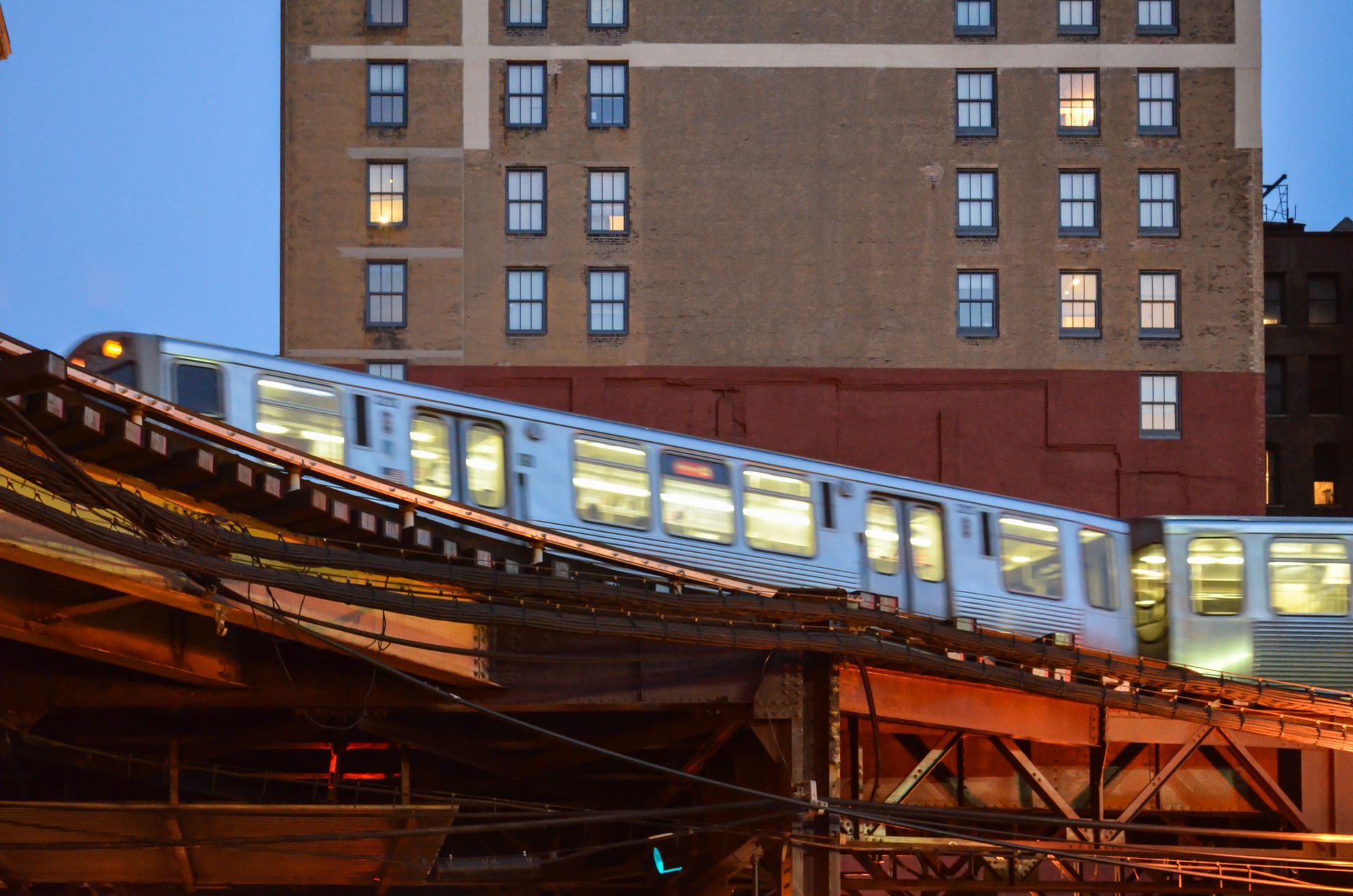
The CTA Blue Line terminates at O'Hare with 24-hour service to downtown, and the ride to the Loop takes about 45 minutes, with trains every few minutes during peak hours.
Metra access
The Metra North Central Service stops at O'Hare Transfer station on the northeast corner of the airport, providing rush-hour rail service to Chicago Union Station.
Forest preserves nearby
The community borders Catherine Chevalier Woods, a 338-acre Forest Preserves of Cook County site along the Des Plaines River, plus Schiller Woods, offering trails and river access minutes from home.
Walk Score 50
O'Hare carries a Walk Score of 50, classified as Somewhat Walkable, so most daily errands involve a car, though proximity to the Blue Line and the Cumberland Avenue retail corridor helps.
Median near $356K
A recent median home price of about $356,000, with a price per square foot near $221, sits meaningfully below the broader Chicago median, making O'Hare one of the more affordable Northwest Side options.
What it’s actually like to live here
Living in O'Hare means waking up to jet noise, and most longtime residents will tell you they stopped hearing it within weeks. The payoffs are real, since for frequent flyers or airport employees the neighborhood puts one of the world's largest airports within a five-minute drive, and for downtown commuters the Blue Line's O'Hare terminus runs 24 hours a day and reaches the Loop in roughly 45 minutes without touching a highway. The neighborhood also connects to Metra's North Central Service at O'Hare Transfer for riders headed to Union Station. Cumberland Avenue serves as the main commercial spine, lined with grocery stores, ethnic restaurants, hardware stores, and services that reflect the area's immigrant-heavy population, and with home prices well below the Chicago median, the neighborhood offers a route into ownership that few Northwest Side communities can match.
The Schorsch Forest View pocket, loosely bounded by Higgins, Montrose, Cumberland, and East River Road, is the heart of O'Hare's residential life, a grid of bungalows, apartment buildings, and two-flats that functions like a self-contained neighborhood within the larger community area. Residents here are organized and locally engaged, with block associations that belie the neighborhood's relative anonymity. The most prized amenity may be immediate access to green space, since Catherine Chevalier Woods sits just west with a 2.6-mile loop trail for hiking and running, and Schiller Woods adds more wooded acreage to the south. Aircraft noise is a real consideration, and prospective buyers should know that more than 12,000 homes near O'Hare have been enrolled in the O'Hare Residential Sound Insulation Program, which installs acoustically rated windows and doors, often at no cost to eligible homeowners. For buyers who want Chicago city services, CPS schools, and a blue-collar community character within earshot of a major international airport, O'Hare delivers something genuinely unusual.
Around town
What there is to do in O'Hare.
A handful of the places people who live here actually use. Not a directory.
- Parks
Catherine Chevalier Woods
This 338-acre Forest Preserves of Cook County site along the Des Plaines River offers an easy 2.6-mile river loop trail for hiking and running, the closest natural escape for O'Hare residents.
- Recreation
Schiller Woods Forest Preserve
Just south of Catherine Chevalier Woods, Schiller Woods offers wooded trails, picnic groves, and Des Plaines River access on the southern edge of the O'Hare community.
- Shopping
Fashion Outlets of Chicago
Minutes from O'Hare in neighboring Rosemont, this two-level indoor outlet mall features more than 130 designer and national brands, the region's premier outlet shopping destination.
- Family
Allstate Arena
This 18,500-seat indoor arena just off Mannheim Road in Rosemont hosts Chicago Wolves hockey, major concerts, Disney On Ice, and family shows throughout the year.
- Food & Drink
Parkway Bank Park Entertainment District
A Rosemont entertainment complex with more than a dozen dining and nightlife venues, including Harry Caray's and a comedy club, plus free summer concerts and fireworks.
- History
O'Hare International Airport
The airport itself, one of the world's busiest since the 1960s, offers aviation history at every turn, from Butch O'Hare namesake displays to the spectacle of continuous international air traffic.
By the numbers
O'Hare taxes + market stats.
Property tax rates vary by exact township and assessor district. Confirm per address before pricing a purchase.
Median sold price
$226,000
MRED · last 12 mo (94 sales)
How O'Hare got here
A bit of history.
The land that is now the O'Hare community area began as a thinly settled Cook County prairie known as Orchard Place, home to a small German-American farming community that grew up around a Wisconsin Central Railroad depot opened in 1887. Its modern identity was forged during World War II, when the War Production Board selected the flat, open land for a massive Douglas Aircraft Company plant in 1942, a facility that produced hundreds of C-54 cargo transports before closing in 1945. After the war, Chicago moved quickly to claim the site for a new commercial airport and acquired most of the property in 1946. The field initially operated as Orchard Douglas Airport, which is why the IATA code is still ORD, and it was renamed in 1949 to honor U.S. Navy pilot Edward Butch O'Hare, the Navy's first Medal of Honor recipient of World War II. Commercial flights began in 1955, and within a generation the airport grew into one of the busiest in the world.
To secure legal control over the airport and its revenue, Chicago executed one of its more creative acts of municipal statecraft in March 1956, annexing not only the airport grounds but also a narrow corridor along Higgins Road that connected the airport territory to the existing city limits. This annexation established O'Hare as the 76th of Chicago's 77 community areas, the only one added to the official map after the 19th-century era of mass annexation. The residential pockets that exist today, particularly Schorsch Forest View on the east side near Higgins and Cumberland, were developed by the Schorsch Brothers in the mid-20th century and marketed to working- and middle-class families who prized affordability and proximity to airport jobs. Over the following decades the neighborhood drew large waves of immigrants, especially from Eastern Europe, and it retains an unpretentious, residential character even as the airport around it became a global gateway.
The questions buyers actually ask
O'Hare FAQ
The questions I get most from buyers shopping O'Hare. If yours isn't here, text 224-385-8779, same-day reply.
- Is O'Hare actually a residential neighborhood, or is it just the airport?
- It is genuinely both. Community Area 76 contains O'Hare International Airport, but it also has a real residential population of roughly 12,000 to 15,000 people living primarily in the Schorsch Forest View pocket near Higgins Road and Cumberland Avenue. The housing stock consists of bungalows, two-flats, and apartment buildings built mostly in the mid-20th century, and the area has active block associations. Most Chicagoans are surprised to learn people actually live there.
- How bad is the aircraft noise, and is there any help for homeowners?
- Aircraft noise is a real factor, particularly under active flight paths. However, the O'Hare Residential Sound Insulation Program has sound-insulated more than 12,000 homes near the airport, installing acoustically rated windows, prime doors, and air conditioning in eligible properties. Prospective buyers should check their specific address for eligibility and whether prior work has been completed, since many homes on the market have already been treated.
- How long does the commute to downtown Chicago take?
- The CTA Blue Line terminates at O'Hare station and runs 24 hours a day, year round. The ride from O'Hare to downtown stops takes about 45 minutes, with trains every 3 to 10 minutes during peak hours. For commuter rail, Metra's North Central Service stops at O'Hare Transfer, though it runs peak-direction rush-hour trains only, making it less flexible than the Blue Line for most riders.
- What are the public schools like in O'Hare?
- The primary public elementary school serving the residential area is Everett McKinley Dirksen Elementary on West Foster Avenue, a CPS PreK through 8th grade school with well over 1,000 students. For high school, students are generally zoned for William Howard Taft High School in neighboring Norwood Park, which has earned Level 1 CPS ratings and national recognition. Private options including parish schools are also available nearby.
- What housing types are available in O'Hare, and what do they cost?
- The residential market is dominated by detached single-family homes, roughly 55 percent of units, followed by two-flats, low-rise multi-unit buildings, and apartment complexes. Most homes were built between the 1940s and 1960s. A recent median home sale price of about $356,000, with a median around $221 per square foot, sits meaningfully below the Chicago-wide medians, making O'Hare one of the more affordable community areas on the Northwest Side.
- Why does Chicago technically own the airport, and what is the neighborhood's origin?
- Chicago executed a clever annexation in March 1956 specifically to claim legal jurisdiction over O'Hare International Airport, connecting the airport territory to its existing boundaries by annexing a narrow corridor along Higgins Road. That made O'Hare Community Area 76, the only addition to Chicago's official community area map since the 19th century. The airport itself traces to a World War II Douglas Aircraft plant known as Orchard Field, which is why the airport code is still ORD.
- Who is the real estate agent for O'Hare?
- Joe Keegan is the local licensed Illinois real estate broker who covers O'Hare in O'Hare, IL through Subdiview, a neighborhood-first home search for the Chicago suburbs and collar counties. Joe prices and negotiates from the live MRED sold comps for O'Hare specifically, not national averages, and can help you buy or sell here. Reach Joe at 224-385-8779 or joe@joekeeganhomes.com.
Nearby
Neighborhoods near O'Hare.
If you’re cross-shopping the area, these are the neighborhoods right next to O'Hare.
Your local agent
Your local agent for O'Hare
Most agents will list anything. I focus on the places I actually know, and the things that move value here don't show up in the MLS write-up: which streets and buildings hold demand, what the HOA or assessments really cover, how the comps read once you account for condition and location, and where buyers consistently want to be.
When you're ready to tour or list, you want someone who has read the last 50 closed comps in this specific market, not a national average, and can tell you what they actually mean for your price. That's how I work. Text or call any time, and I'll give you a real take, not a brochure.
- Licensed Illinois broker
- Comp-driven pricing
- O'Hare specialist
- Honest local market take
- Brokerocity
Thinking of selling?
What's your home actually worth?
Not a Zestimate. A real CMA built on the homes that actually sold around you, adjusted for the floor plan, condition and upgrades that move the price.
- Pricing range with comp-by-comp logic
- Pre-list improvements that pay back, and the ones that don't
- No obligation, no spam, no auto-dialer