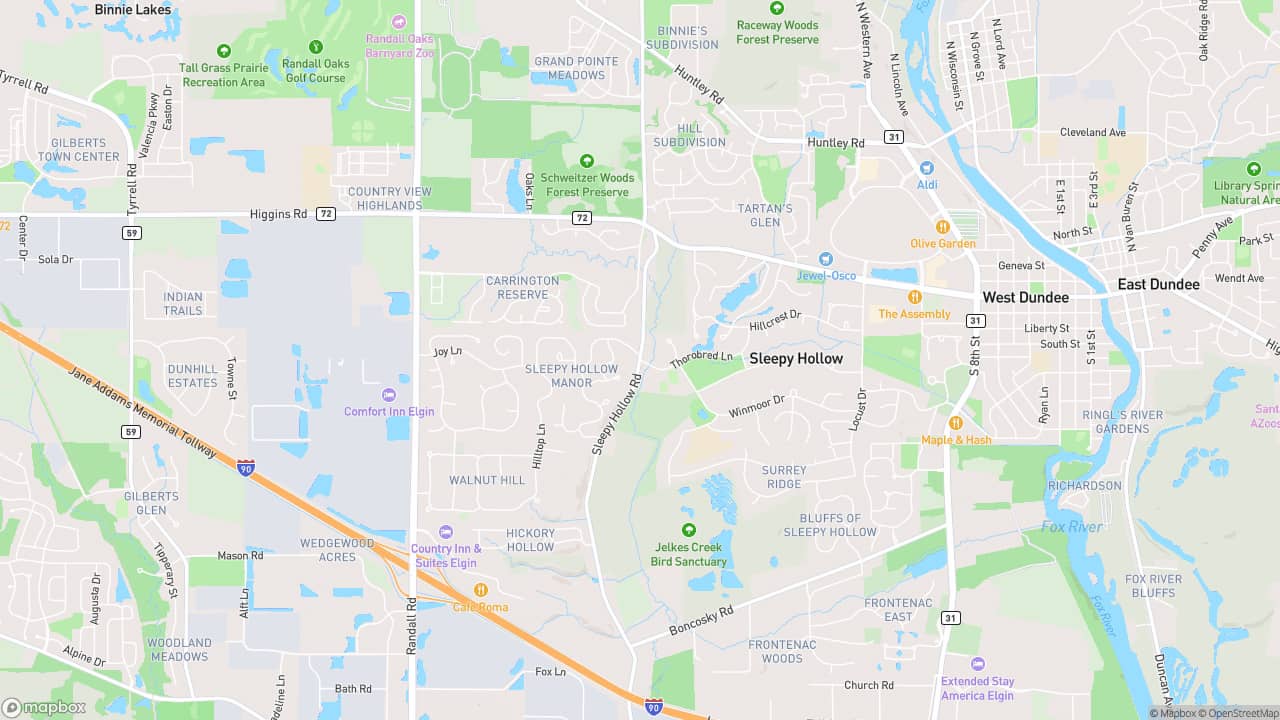
Sleepy Hollow · Kane County · IL
Homes for sale in
Sleepy Hollow.
- Active listings
- 4
- Median list
- $507K
- Avg time on market
- 3 days
- Sold · last year
- 46
Active listings
4 homes on the market


Be the first to know when a new Sleepy Hollow home hits the market
Text + email the moment a new listing matches.
About the community
Living in Sleepy Hollow.
Sleepy Hollow is a small village in northeastern Kane County, bordered by West Dundee to the north and east and by Elgin to the south and west, with the Fox River a short drive east. It was platted in the 1950s by Floyd T. Falese, who hired landscape architect Raymond W. Hazekamp to lay out meandering, curbless, sidewalk-free streets that wound around the existing trees of the old Sleepy Hollow Farm. Residents voted to incorporate as a village in March 1958 rather than be annexed by West Dundee, and the community has stayed deliberately low-density ever since. Public school children attend Sleepy Hollow Elementary, Dundee Middle, and Dundee-Crown High School, all part of Community Unit School District 300. The 2020 census recorded a population of 3,214 across about 1,213 households, with a median household income of $122,121.
At a glance
~3,200 residents
3,214 at the 2020 census across 1,213 households. Population has been stable for decades by design.
Large wooded lots
R-1 zoning calls for an average lot size of 80,000 sq ft (about 1.84 acres) with a minimum of 40,000 sq ft (about 0.92 acres). Much larger than typical Chicago-area subdivisions.
D300 - Dundee-Crown HS
Sleepy Hollow Elementary is inside the village, then Dundee Middle and Dundee-Crown High School in Carpentersville. All under Community Unit School District 300.
Planned community, 1958
Platted by Floyd T. Falese in the 1950s and incorporated April 29, 1958 after a 40 to 6 vote to avoid annexation by West Dundee.
No commercial district
By design. Zoning restricts commercial uses to small B-1 and B-2 districts on Randall Road and Route 72 frontage to protect the residential character.
Higher-income, older village
Median household income $122,121 (2020 census) with a median age around 49. Skews wealthier and older than the surrounding area.
Surrounded by arterials
Randall Road on the west, IL Route 72 on the north, IL Route 31 just east, and I-90 a short drive south.
Fox River corridor nearby
Route 31 and the Fox River run just east of the village, with the Brunner Family Forest Preserve and Fox River Trail a short drive away.
What’s close
Sleepy Hollow sits in northeastern Kane County, bordered by West Dundee on the north and east and by Elgin on the south and west, with Randall Road forming its western edge, IL Route 72 along the north, and I-90 a short drive south.
- Bordered by West Dundee and Elgin
- West Dundee wraps the north and east, Elgin wraps the south and west. Carpentersville and East Dundee are in the same Dundee Township.
- Planned community by Floyd T. Falese
- Designed in the 1950s with curving, curbless, sidewalk-free streets laid out by landscape architect Raymond W. Hazekamp around the mature trees of the original Sleepy Hollow Farm.
- No commercial downtown
- Zoning code restricts commercial uses to small B-1 and B-2 districts on Randall Road and Route 72 frontage. Most of the village is R-1 residential by intent.
- Sleepy Hollow Park
- The village's central park at 145 Thorobred Lane, maintained by Public Works with help from resident volunteers.
- D300 schools
- Sleepy Hollow Elementary inside the village, then Dundee Middle and Dundee-Crown High School in Carpentersville, all under Community Unit School District 300.
- Fox River corridor
- Route 31 and the Fox River run just east. Brunner Family Forest Preserve and the Fox River Trail are a short drive away.
What it’s actually like to live here
Day-to-day life in Sleepy Hollow leans on the village's defining feature: large wooded lots on quiet, curving streets with no curbs and no sidewalks, laid out in the 1950s to preserve the trees of the original farm. The R-1 residential zone calls for an average lot size of 80,000 square feet and a minimum of 40,000 square feet, which is roughly an acre on average and just under one acre at minimum, much larger than typical Chicago-area subdivisions. Mid-century ranches sit on rolling, partially wooded parcels, and most properties feel more rural than suburban.
Because Sleepy Hollow has no commercial district by design, residents drive a few minutes for groceries, restaurants, and shopping. West Dundee's Spring Hill Mall corridor and Randall Road handle most retail and dining, the Dundee Township Park District operates the Sleepy Hollow Pool inside the village and the Randall Oaks Recreation Center, golf course, and zoo just to the north, and the Fox River trail system and Brunner Family Forest Preserve provide outdoor space a short drive east. Santa's Village Amusement and Water Park in East Dundee anchors family entertainment in the surrounding township.
Neighborhoods
Sleepy Hollow neighborhoods
1 neighborhood in Sleepy Hollow, each with its own page covering market stats, schools, and what the buyers there are optimizing for. Featured neighborhoods have hand-curated content; the rest auto- update from MRED listing data.
This representation is based in whole or in part on data supplied by Midwest Real Estate Data, LLC for the period September 13, 2025 through September 13, 2026. Midwest Real Estate Data, LLC does not guarantee nor is it in any way responsible for its accuracy. Data maintained by Midwest Real Estate Data LLC may not reflect all real estate activity in the market.
Schools
Districts serving Sleepy Hollow.
Boundary lines do shift. Always confirm in writing for a specific address before writing an offer.
- D300Grades Pre-K - 12
Community Unit School District 300
Schools serving the area
- Dundee-Crown High School
- Dundee Middle School
- Sleepy Hollow Elementary School
Sleepy Hollow Elementary is physically inside the village. Students then attend Dundee Middle School and Dundee-Crown High School in Carpentersville. Dundee-Crown serves about 2,391 students drawn from Algonquin, Carpentersville, East Dundee, West Dundee, Sleepy Hollow, southwest Cary, southwest Fox River Grove, and western Barrington Hills.
Around town
What there is to do in Sleepy Hollow.
A handful of the places people who live here actually use. Not a directory.
- Parks
Sleepy Hollow Park
The village's central park at 145 Thorobred Lane, maintained by Public Works with help from resident volunteers.
- Family
Sleepy Hollow Pool (Dundee Township Park District)
Outdoor seasonal pool inside Sleepy Hollow, operated by the Dundee Township Park District alongside Dolphin Cove and the indoor Rakow Center pool.
- Parks
Brunner Family Forest Preserve
723-acre Kane County preserve on the Fox River in nearby Carpentersville, with nearly 5 miles of trails, fishing access, and a picnic shelter.
- Parks
Raceway Woods Forest Preserve
122-acre Kane County preserve in Carpentersville with over 5 miles of flowy multi-use singletrack on the site of an old race track.
- Family
Santa's Village Amusement and Water Park
Family theme park in East Dundee operating since 1959, with rides, a petting zoo, and Santa Springs water park under pay-one-price admission.
- Shopping
Spring Hill Mall
Regional shopping mall in West Dundee anchored by Kohl's, the Cinemark theater, and chain dining, just east of Sleepy Hollow off Route 72.
Getting around
Commute + transit from Sleepy Hollow.
- Routes: Randall Road · IL 72 · IL 31 · I-90
- O'Hare Airport: ~30 min
- Chicago Loop: ~62 min
By the numbers
Sleepy Hollow taxes + market stats.
Property tax rates vary by exact township and assessor district. Confirm per address before pricing a purchase.
Property tax rate
2.47%
effective avg
Sales tax
7.25%
combined
Median sold price
$480,000
MRED · last 12 mo (46 sales)
Median household income
$122,121
ACS
How Sleepy Hollow got here
A bit of history.
The village traces to 1953, when Floyd T. Falese bought the 340-acre Sleepy Hollow Farm, built a house called Singing Waters with two lakes and a waterfall, and began subdividing the land as Sleepy Hollow Manor. Falese retained planner and landscape architect Raymond W. Hazekamp, who laid out a pattern of meandering roads without curbs or sidewalks, winding into curvilinear cul-de-sacs designed to avoid destroying a single tree and to preserve the rural character of the farm. The name nods to Washington Irving's 1820 story The Legend of Sleepy Hollow, and several street names in the village still reference the tale.
On March 12, 1958, residents held a referendum and voted 40 to 6 to incorporate as a village rather than be annexed by West Dundee, with the court order officially incorporating Sleepy Hollow signed by Judge Charles Seidel on April 29, 1958. Falese was elected village president that April and served until his death in 1970. The population grew from 311 in 1960 to 1,729 in 1970, and has since stabilized at roughly 3,200, with the 2020 census recording 3,214 residents. The village remains primarily residential, with limited commercial zoning intended to preserve its low-density character.
The questions buyers actually ask
Sleepy Hollow FAQ
The questions I get most from buyers shopping Sleepy Hollow. If yours isn't here, text 224-385-8779, same-day reply.
- Why are there no shops or restaurants in Sleepy Hollow?
- By design. The village was platted in the 1950s as a residential community and its zoning code restricts commercial uses to small B-1 and B-2 districts on Randall Road and Route 72 frontage, intended to have no deleterious effect on the residential character. Most of the village is R-1 residential. Residents drive a few minutes to West Dundee, Carpentersville, or Elgin for retail.
- What school district is Sleepy Hollow in?
- Sleepy Hollow is served by Community Unit School District 300 (D300). The village has its own Sleepy Hollow Elementary School, then students attend Dundee Middle School and Dundee-Crown High School in Carpentersville. Always verify by address.
- Is the village name connected to Washington Irving's Legend of Sleepy Hollow?
- Yes. The village is named for Irving's 1820 short story, and several streets reference the tale. The local Sleepy Hollow Farm name predated the village and was kept when Floyd T. Falese subdivided the property as Sleepy Hollow Manor in the 1950s.
- How big are the lots in Sleepy Hollow?
- The R-1 residential code calls for an average lot size of 80,000 square feet (about 1.84 acres) and a minimum of 40,000 square feet (about 0.92 acres), well above typical Chicago-area subdivisions. That is the heart of the village's planned-community character: large wooded parcels with no curbs and no sidewalks.
- How long is the commute to Chicago or O'Hare?
- Sleepy Hollow is about 26 miles from O'Hare International Airport (roughly 27 to 33 minutes by car) and about 41 miles from the Chicago Loop (about 1 hour 2 minutes off-peak). The closest Metra station is Big Timber Road in Elgin, about 3 miles away on the Milwaukee District West line, with weekday-only service.
- What are the property and sales taxes like in Sleepy Hollow?
- The median effective property tax rate is about 2.47 percent. The combined sales tax rate is 7.25 percent (6.25 percent Illinois plus 1.00 percent Regional Transportation Authority and Kane County). Sleepy Hollow imposes no municipal sales tax of its own, which is unusual for a Kane County village.
- Who is the real estate agent for Sleepy Hollow?
- Joe Keegan is the local licensed Illinois real estate broker who covers Sleepy Hollow in Sleepy Hollow, IL through Subdiview, a neighborhood-first home search for the Chicago suburbs and collar counties. Joe prices and negotiates from the live MRED sold comps for Sleepy Hollow specifically, not national averages, and can help you buy or sell here. Reach Joe at 224-385-8779 or joe@joekeeganhomes.com.
Nearby
Towns next to Sleepy Hollow.
If you’re cross-shopping the area, these are the places that border Sleepy Hollow.
Your local agent
Joe knows Sleepy Hollow
Most agents will list anything. I focus on the places I actually know, and the things that move value here don't show up in the MLS write-up: which streets and buildings hold demand, what the HOA or assessments really cover, how the comps read once you account for condition and location, and where buyers consistently want to be.
When you're ready to tour or list, you want someone who has read the last 50 closed comps in this specific market, not a national average, and can tell you what they actually mean for your price. That's how I work. Text or call any time, and I'll give you a real take, not a brochure.
- Licensed Illinois broker
- Comp-driven pricing
- Sleepy Hollow specialist
- Honest local market take
- Brokerocity
Thinking of selling?
What's your home actually worth?
Not a Zestimate. A real CMA from someone who's sold this neighborhood, knows the floor plan premiums, and can tell you which upgrades the buyer pool here actually pays for.
- Pricing range with comp-by-comp logic
- Pre-list improvements that pay back, and the ones that don't
- No obligation, no spam, no auto-dialer