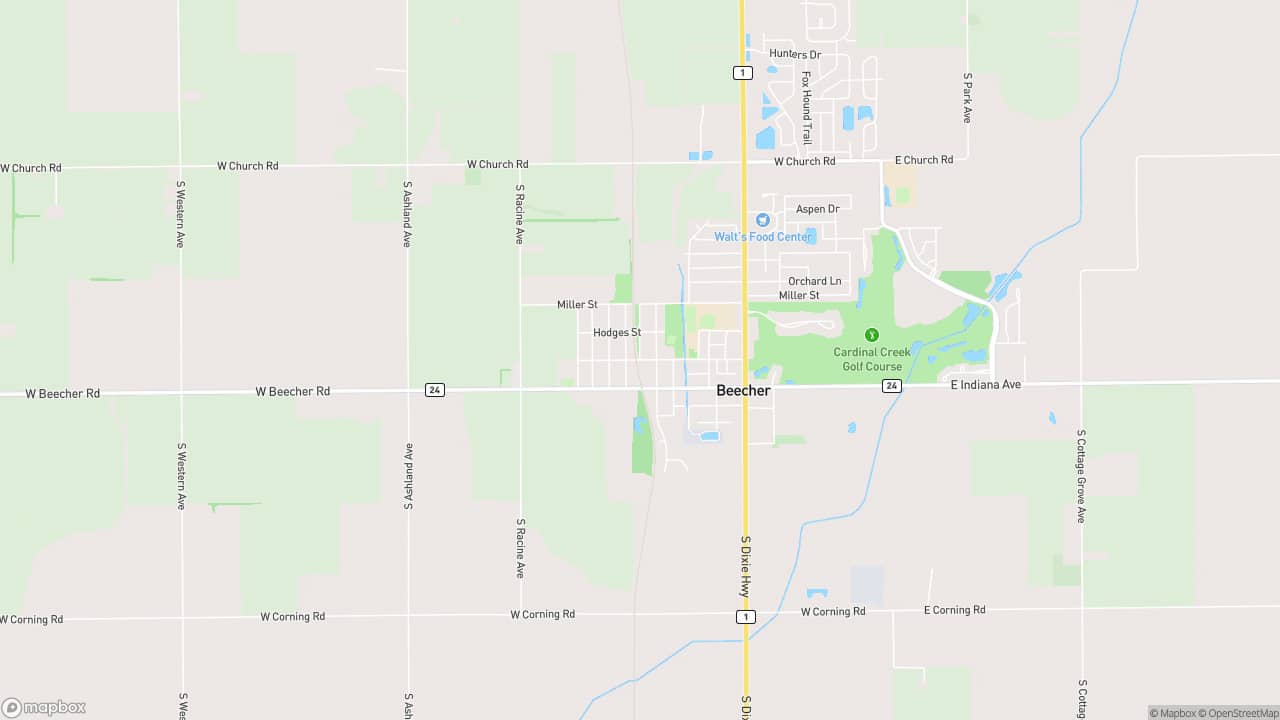
Beecher · Will County · IL
Homes for sale in
Beecher.
- Active listings
- 28
- Median list
- $357K
- Avg time on market
- 19 days
- Sold · last year
- 34
Active listings
28 homes on the market


Be the first to know when a new Beecher home hits the market
Text + email the moment a new listing matches.
About the community
Living in Beecher.
Beecher is a small Will County village of about 4,700 people that has held onto its agricultural, small-town character even as the south suburbs of Chicago grew around it. Founded in 1870 along the old Chicago and Eastern Illinois rail line and named for the orator Henry Ward Beecher, the village still centers on its restored 1881 train depot and the parks and ballfields where generations of families have gathered. Buyers here are typically drawn by detached single-family homes on larger lots, a high homeownership rate of roughly 81 percent, and a quieter pace than you find closer to the city. The trade-off is a longer commute, with an average travel time near 29 minutes, but the IL-1 (Dixie Highway) corridor and the nearby University Park Metra terminal keep Chicago and Joliet within reach. If you want acreage-adjacent privacy and a tight community feel without leaving the Chicago metro entirely, Beecher is worth a close look.
At a glance
About 4,700 residents
Beecher had 4,713 residents at the 2020 census, a small village surrounded by farmland.
Founded 1870
The village was platted in 1870 along the railroad and incorporated in 1884.
Rural character
The 2020 census classified the village as a rural community surrounded by Washington Township farmland.
High homeownership
About 81 percent of housing units are owner-occupied, well above the national average.
Median income
The median household income is roughly $103,000.
One district
The village is served almost entirely by Beecher CUSD 200U from preschool through grade 12.
Dixie Highway
Beecher sits on historic IL-1 (Dixie Highway), its main north-south spine.
Golf in town
The 27-hole Cardinal Creek Golf Club sits right on Dixie Highway in the village.
What’s close
Beecher sits in far southeastern Will County on the IL-1 (Dixie Highway) corridor, near the Indiana state line and roughly 40 miles south of downtown Chicago.
- County
- Will County, in the village's Washington Township.
- Distance to Chicago
- About 40 miles south of downtown Chicago by road and rail.
- Nearest big neighbor
- Crete is about 7 miles north.
- State line
- Close to the Illinois-Indiana border, with Cedar Lake, Indiana about 10 miles east.
- Main corridor
- IL-1 (Dixie Highway) runs north-south through the village.
- Commuter rail access
- The University Park Metra Electric terminal is the closest station, roughly 10 miles away.
What it’s actually like to live here
Day-to-day life in Beecher revolves around its parks and its compact, walkable village core. The village maintains ten parks offering walking paths, ballfields, soccer fields, and playgrounds, anchored by ten-acre Welton Stedt Park next to the junior high and by Firemen's Park in the heart of town, which adds picnic pavilions, a stage, a snack shack, and a seasonal ice rink. Community events such as the long-running Fourth of July festival give the village a genuine small-town rhythm.
For everyday needs, residents lean on local mainstays and the larger retail of nearby Crete and the south suburbs, while golfers have a 27-hole course right in town at Cardinal Creek. Most households own two cars and commute out for work, with an average commute close to 29 minutes, so Beecher tends to suit buyers who value space, quiet, and community over walk-to-everything convenience. The result is a settled, family-oriented place where neighbors know each other and the surrounding farmland is never far from view.
Neighborhoods
Beecher neighborhoods
1 neighborhood in Beecher, each with its own page covering market stats, schools, and what the buyers there are optimizing for. Featured neighborhoods have hand-curated content; the rest auto- update from MRED listing data.
This representation is based in whole or in part on data supplied by Midwest Real Estate Data, LLC for the period September 27, 2025 through September 27, 2026. Midwest Real Estate Data, LLC does not guarantee nor is it in any way responsible for its accuracy. Data maintained by Midwest Real Estate Data LLC may not reflect all real estate activity in the market.
Schools
Districts serving Beecher.
Boundary lines do shift. Always confirm in writing for a specific address before writing an offer.
- 200UGrades PK-12
Beecher Community Unit School District 200U
Schools serving the area
- Beecher Elementary School
- Beecher Junior High School
- Beecher High School
Beecher CUSD 200U serves Washington Township plus a large rural section of neighboring Will Township, covering nearly all of the village from preschool through grade 12.
Homes by school
Homes for sale by school in Beecher
Around town
What there is to do in Beecher.
A handful of the places people who live here actually use. Not a directory.
- Parks
Firemen's Park
A central village park with picnic pavilions, a stage, ballfields, walking paths, a snack shack, and a seasonal ice rink, longtime home of the Fourth of July festival.
- Parks
Welton Stedt Park
The village's largest park at ten acres, located next to Beecher Junior High, with four ballfields and a pond.
- Culture
Beecher Depot Museum
The restored 1881 train depot, returned to its original site in 2000, now home to the local historical society.
- Family
Cardinal Creek Golf Club
A 27-hole public golf course at 615 Dixie Highway offering three 18-hole routings plus a bar and grill.
- Family
Beecher Farmers Market
A seasonal community farmers market featuring local vendors and produce.
- Culture
Ribbon of Hope Cancer Awareness Garden
A village commission garden in Firemen's Park, centered on a metallic ribbon sculpture dedicated in 2018.
Getting around
Commute + transit from Beecher.
- Routes: IL-1 (Dixie Highway) · IL-394 (nearby) · I-57 (nearby via Monee)
- Crete: ~12 min
- Frankfort: ~36 min
- Chicago Loop: ~51 min
By the numbers
Beecher taxes + market stats.
Property tax rates vary by exact township and assessor district. Confirm per address before pricing a purchase.
Property tax rate
2.77%
effective avg
Sales tax
8.00%
combined
Median sold price
$329,450
MRED · last 12 mo (34 sales)
Median household income
$103,415
ACS
How Beecher got here
A bit of history.
Beecher began in 1870 when T.L. Miller, a Chicago insurance man and admirer of the orator Henry Ward Beecher, bought up farmland in the center of Washington Township to breed Hereford cattle on what he called Highland Stock Farm. When the Chicago, Danville and Vincennes Railroad came through, Miller secured a station and asked George Dolton to lay out a village, with a business section on both sides of the tracks and twelve blocks beyond for homes. Originally called Washington Center, the community was renamed Beecher, incorporated as a village in 1884, and grew up around the depot that became the heart of town. Miller's herd and his Hereford herd book, both published in Beecher, helped spread the breed across America.
Beecher's enduring character is rooted in the German Lutheran farming families who settled Washington Township in the nineteenth century, a heritage still visible in the village's churches and cemeteries. The original 1881 wooden depot, one of the last of its kind on the former Chicago and Eastern Illinois route, was sold and moved to Monee for years before being returned to its original site in 2000 and restored as the home of the local historical society. Today the village remains surrounded by working farmland and keeps small-town traditions alive, including a Fourth of July festival that has been held in Firemen's Park for decades.
The questions buyers actually ask
Beecher FAQ
The questions I get most from buyers shopping Beecher. If yours isn't here, text 224-385-8779, same-day reply.
- What school district serves Beecher, IL?
- Beecher is served by Beecher Community Unit School District 200U, a PK-12 district with Beecher Elementary, Beecher Junior High, and Beecher High School. The district covers Washington Township plus a large rural section of Will Township.
- How is the commute from Beecher to Chicago?
- Most residents commute by car, with an average commute around 29 minutes and roughly a 50-minute drive to downtown Chicago. The closest Metra rail option is the University Park station on the Metra Electric line, about 10 miles away, which connects to Millennium Station downtown.
- What are property taxes like in Beecher?
- Beecher's median effective property tax rate is about 2.77 percent, in line with the higher rates across Will County. Pull the actual tax bill for a specific address and factor in local levies and exemptions when you budget.
- Where should I look for homes in Beecher?
- Most of the market is detached single-family homes, with around 81 percent owner-occupied. The village core sits along IL-1 (Dixie Highway), and newer subdivisions and larger-lot properties spread out toward the surrounding farmland within ZIP code 60401.
- What is Beecher, IL like to live in?
- Beecher is a small, family-oriented village of about 4,700 people with a rural, agricultural backdrop and a tight community feel. Life centers on its ten village parks, the restored historic depot, a 27-hole golf course, and long-running events like the Fourth of July festival in Firemen's Park.
- How much do homes cost in Beecher?
- Recent Census data puts the median home value around $269,500, though estimates range from roughly $242,000 into the low $280,000s depending on the source. Values have been rising in recent years.
- Is Beecher a good place for families?
- It tends to be. The village offers a single small district from preschool through high school, abundant parks and ballfields, a high homeownership rate, and a quiet, established neighborhood character, all within commuting range of the south suburbs and Chicago.
- Who is the real estate agent for Beecher?
- Joe Keegan is the local licensed Illinois real estate broker who covers Beecher in Beecher, IL through Subdiview, a neighborhood-first home search for the Chicago suburbs and collar counties. Joe prices and negotiates from the live MRED sold comps for Beecher specifically, not national averages, and can help you buy or sell here. Reach Joe at 224-385-8779 or joe@joekeeganhomes.com.
Your local agent
Joe knows Beecher
Most agents will list anything. I focus on the places I actually know, and the things that move value here don't show up in the MLS write-up: which streets and buildings hold demand, what the HOA or assessments really cover, how the comps read once you account for condition and location, and where buyers consistently want to be.
When you're ready to tour or list, you want someone who has read the last 50 closed comps in this specific market, not a national average, and can tell you what they actually mean for your price. That's how I work. Text or call any time, and I'll give you a real take, not a brochure.
- Licensed Illinois broker
- Comp-driven pricing
- Beecher specialist
- Honest local market take
- Brokerocity
Thinking of selling?
What's your home actually worth?
Not a Zestimate. A real CMA from someone who's sold this neighborhood, knows the floor plan premiums, and can tell you which upgrades the buyer pool here actually pays for.
- Pricing range with comp-by-comp logic
- Pre-list improvements that pay back, and the ones that don't
- No obligation, no spam, no auto-dialer