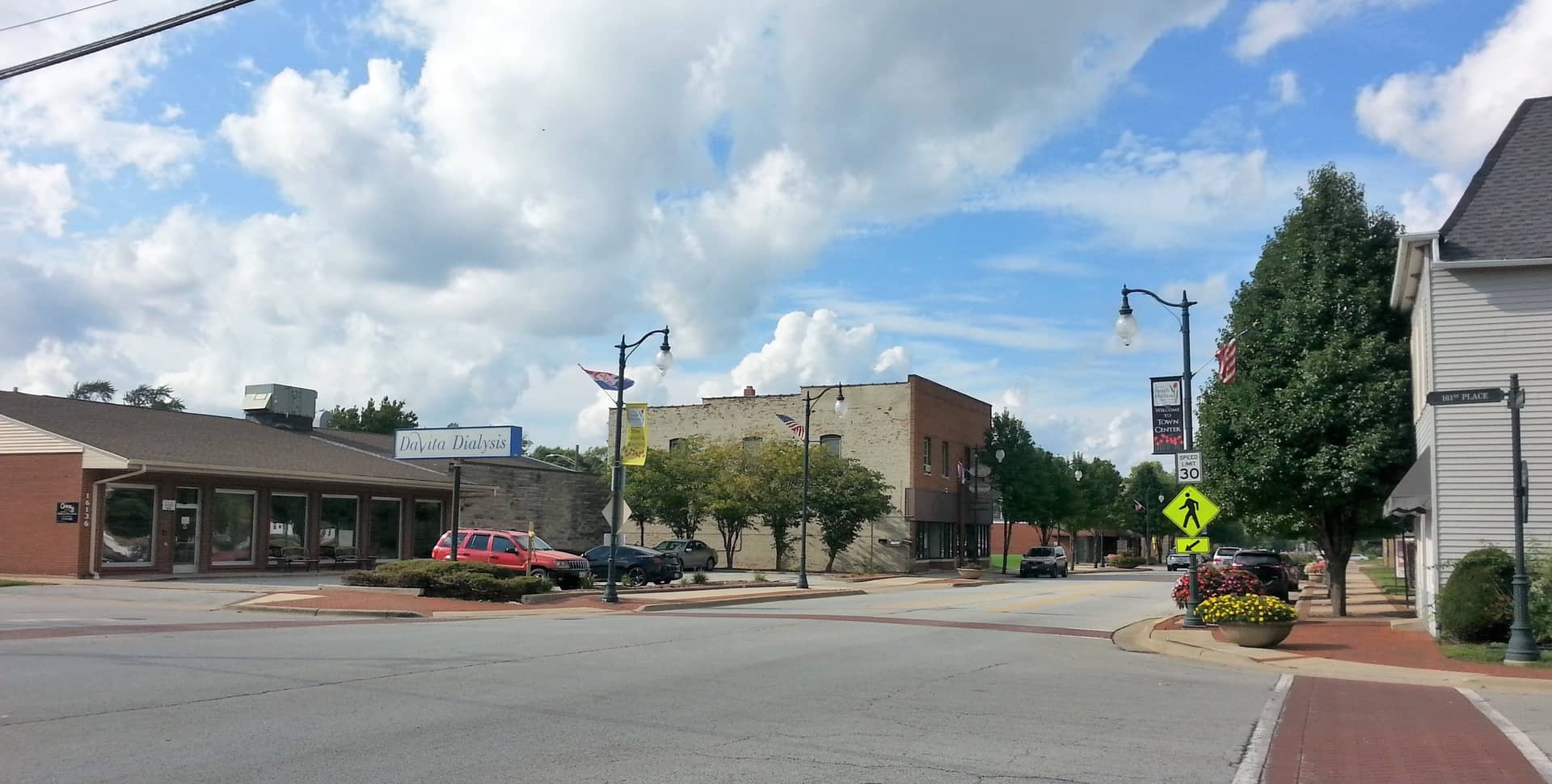
South Holland · Cook County · IL
Homes for sale in
South Holland.
- Active listings
- 97
- Median list
- $239K
- Avg time on market
- 18 days
- Sold · last year
- 261
Active listings
97 homes on the market


Be the first to know when a new South Holland home hits the market
Text + email the moment a new listing matches.
About the community
Living in South Holland.
South Holland is a village in Thornton Township in south Cook County, near the junction of major expressways where I-80 and I-94 meet and I-294 begins. The community was first settled in 1846 by Dutch immigrants from the province of South Holland in the Netherlands, and it remains named for that homeland. Originally a farming community, it specialized in onion sets and by the 1940s was known as the Onion Set Capital of the World. Its conservative Dutch Reformed roots gave it a long tradition of faith institutions and a dry, no-alcohol-sales heritage that lasted until very recently. Today South Holland is a predominantly Black middle-class suburb of about 21,465 residents, and the Metra Electric District main line serving the area offers commuter rail access toward downtown Chicago's Millennium Station.
At a glance
About 21,500 residents
The 2020 census counted 21,465 residents in roughly 7,452 households.
Family character
A settled, owner-oriented suburb where most households are families and a large share include children under 18.
Schools
Served by elementary districts SD 150 and SD 151, with Thornton Township High School District 205; Thornwood High School is in South Holland.
Transit and highways
Near the I-80/I-94 and I-294 junction, with Metra Electric District main line stations serving the immediate area.
Dutch and onion heritage
Founded by Dutch settlers in 1846 and known by the 1940s as the Onion Set Capital of the World.
Faith community
Conservative Dutch Reformed roots produced a long-standing dry, no-alcohol-sales tradition until recent years.
Property taxes
A high south-Cook effective property tax rate of about 4.25 percent, offset somewhat by moderate home prices.
South Suburban College
Home to the main campus of South Suburban College since 1972.
What’s close
South Holland sits in south Cook County at the convergence of major Chicago-area expressways, with the Metra Electric main line running through the immediate area and Cook County forest preserves along Thorn Creek nearby.
- Expressway crossroads
- South Holland is where I-80 and I-94 intersect and where I-294, the Tri-State Tollway, begins its route north toward O'Hare.
- Metra Electric District main line
- The Metra Electric main line, terminating downtown at Millennium Station, runs through the adjacent Calumet corridor with nearby stations at Riverdale, Ivanhoe, and 147th Street / Sibley.
- Commercial corridors
- South Holland's numbered streets run three blocks ahead of Chicago's grid, aligning its main commercial corridors with the regional grid.
- Thorn Creek forest preserves
- Cook County forest preserves, including Wampum Lake, follow Thorn Creek near South Holland and connect to the Thorn Creek trail system.
- Veterans Memorial Park
- A village park with two baseball fields, a playground, gazebos, a pond, war memorials, and a paved walking trail.
- Calumet region position
- The village was built on low ground near the Calumet River in the Calumet region of south suburban Chicago.
What it’s actually like to live here
South Holland is a settled, owner-oriented residential community where most households are families and a sizable share include children under 18. The housing stock developed largely during its mid-20th-century growth, when the population climbed from a few thousand in 1940 to roughly 24,000 by 1970, producing established neighborhoods of mid-century single-family homes. Median home values run below the Illinois state average, which keeps the cost of a single-family home relatively accessible for a Chicago suburb. In 2007 Forbes named South Holland the most livable suburb in the Chicago metro region.
Community life in South Holland is strongly shaped by its faith traditions, a legacy of its founding by conservative Dutch Reformed settlers, and for generations the village famously prohibited alcohol sales anywhere within its limits. Residents have access to local green space such as the roughly 21-acre Veterans Memorial Park, with ball fields, playgrounds, a pond, and a walking trail, as well as nearby Cook County forest preserves and nature centers along Thorn Creek. The village is also home to the main campus of South Suburban College and the South Holland Public Library, anchoring local education and culture.
Neighborhoods
Detailed South Holland community pages coming soon.
Browse the listings above. Detailed neighborhood pages with market stats, school info, and lifestyle take-downs land here as we roll them out.
Schools
Districts serving South Holland.
Boundary lines do shift. Always confirm in writing for a specific address before writing an offer.
- SD 150Grades K - 8
South Holland School District 150
Schools serving the area
- Greenwood School
- McKinley School
One of two elementary districts serving South Holland. Assignment depends on address.
- SD 151Grades Pre-K - 8
South Holland School District 151
Schools serving the area
- Taft School
- Eisenhower School
- Madison School
- Coolidge Junior High School
The second elementary district serving South Holland. Confirm the assigned district per address.
- D205Grades 9 - 12
Thornton Township High School District 205
Schools serving the area
- Thornwood High School (in South Holland)
- Thornridge High School
- Thornton Township High School
District 205 serves all of South Holland for high school, and Thornwood High School is located within the village.
Around town
What there is to do in South Holland.
A handful of the places people who live here actually use. Not a directory.
- Culture
Paarlberg Homestead Museum and Historic Site
An 1870 Dutch farmstead built by Peter Paarlberg, donated to the South Holland Historical Society in 1970 and preserved in a municipal park.
- Family
Sand Ridge Nature Center
A Forest Preserves of Cook County nature center on Paxton Avenue in South Holland, with exhibits on Calumet-region natural history and reproduction 19th-century log cabins.
- Parks
South Holland Veterans Memorial Park
A village park with ball fields, a playground, gazebos, a pond, war memorials, and a paved walking trail.
- Parks
Wampum Lake
A Forest Preserves of Cook County lake offering year-round fishing along the course of Thorn Creek near South Holland.
- Culture
South Holland Public Library
The village library on Wausau Avenue, which also houses the South Holland Historical Society Museum on its lower level.
- Family
South Suburban College
The public community college whose main campus has been in South Holland since 1972.
Getting around
Commute + transit from South Holland.
- Stations: Riverdale, Ivanhoe, 147th Street / Sibley
- Terminal: Chicago Millennium Station
- Routes: I-80 / I-94 (Bishop Ford and Kingery) · I-294 (Tri-State Tollway) · IL 394 · US Route 6
- Chicago Loop: ~30 min
- O'Hare Airport: ~45 min
By the numbers
South Holland taxes + market stats.
Property tax rates vary by exact township and assessor district. Confirm per address before pricing a purchase.
Property tax rate
4.25%
effective avg
Sales tax
9.50%
combined
Median sold price
$225,000
MRED · last 12 mo (261 sales)
Median household income
$66,859
ACS
How South Holland got here
A bit of history.
The area now occupied by South Holland was first settled in 1846 by immigrants from the province of South Holland in the Netherlands, part of a chain migration in which a large share of Dutch migrants from that region settled in just a few American towns. The settlement was built on low ground near the Calumet River and was originally called de Laage Prairie, or Low Prairie, to distinguish it from a Dutch settlement on higher ground to the north, now Chicago's Roseland neighborhood. The community formally incorporated as a village on May 12, 1894, with a population of about 1,000. It began as a general farming community, later specialized in vegetable growing, especially onion sets, and by the 1940s South Holland was known as the Onion Set Capital of the World.
South Holland grew rapidly in the mid-20th century, with its population rising from 2,272 in 1940 to over 10,000 by 1960 and peaking near 24,000 around 1970. The village's conservative Dutch Reformed religious roots shaped a long-standing dry tradition in which no alcohol was sold anywhere within village limits, a remnant of its founding that endured until the village granted its first liquor license only in recent years. Over the following decades the community transitioned demographically, and by the 2020 census it had become a predominantly Black middle-class suburb, with Black or African American residents making up roughly 80 percent of the population.
The questions buyers actually ask
South Holland FAQ
The questions I get most from buyers shopping South Holland. If yours isn't here, text 224-385-8779, same-day reply.
- What schools serve South Holland?
- South Holland is served by two elementary districts, South Holland School District 150 with Greenwood and McKinley schools, and South Holland School District 151 with Taft, Eisenhower, Madison, and Coolidge schools. For high school, all of South Holland is served by Thornton Township High School District 205, and Thornwood High School is located within the village. Elementary assignment depends on address, so confirm before writing an offer.
- How is the commute to downtown Chicago?
- South Holland is roughly 22 miles from downtown Chicago, about a 30-minute drive via the area's expressways. The Metra Electric District main line, which terminates at Millennium Station downtown, serves the immediate area with nearby stations at Riverdale, Ivanhoe, and 147th Street / Sibley, and Pace buses connect South Holland across the Southland.
- Are property taxes high in South Holland?
- Yes. Like much of south Cook County, South Holland carries a high effective property tax rate, reported at about 4.25 percent, well above the national median. Buyers should budget carefully for property taxes, though relatively moderate home prices partly offset the rate. Always confirm by pulling the actual tax bill for the specific address.
- What is the Dutch and onion heritage about?
- South Holland was first settled in 1846 by Dutch immigrants from the province of South Holland in the Netherlands, and the village is named for that homeland. It began as a farming community that specialized in onion sets, and by the 1940s it was known as the Onion Set Capital of the World. That heritage is preserved today at sites like the 1870 Paarlberg Homestead.
- Is South Holland a faith-oriented community, and can you buy alcohol there?
- South Holland was founded by conservative Dutch Reformed settlers, and that faith heritage gave the village a long-standing dry tradition in which alcohol was not sold anywhere within village limits. The village only recently began allowing limited alcohol service, granting its first liquor license in recent years while signaling it has no interest in liquor stores.
- Is South Holland a good place to buy a family home?
- South Holland is a settled, family-oriented suburb where most households are families and a substantial share include children, and Forbes named it the most livable Chicago metro suburb in 2007. Median home values run below the Illinois state average, and the village offers parks, a community college, and a public library. It remains a popular choice for buyers who want an established south-suburban community with strong civic and faith institutions.
- Who is the real estate agent for South Holland?
- Joe Keegan is the local licensed Illinois real estate broker who covers South Holland in South Holland, IL through Subdiview, a neighborhood-first home search for the Chicago suburbs and collar counties. Joe prices and negotiates from the live MRED sold comps for South Holland specifically, not national averages, and can help you buy or sell here. Reach Joe at 224-385-8779 or joe@joekeeganhomes.com.
Nearby
Towns next to South Holland.
If you’re cross-shopping the area, these are the places that border South Holland.
Your local agent
Joe knows South Holland
Most agents will list anything. I focus on the places I actually know, and the things that move value here don't show up in the MLS write-up: which streets and buildings hold demand, what the HOA or assessments really cover, how the comps read once you account for condition and location, and where buyers consistently want to be.
When you're ready to tour or list, you want someone who has read the last 50 closed comps in this specific market, not a national average, and can tell you what they actually mean for your price. That's how I work. Text or call any time, and I'll give you a real take, not a brochure.
- Licensed Illinois broker
- Comp-driven pricing
- South Holland specialist
- Honest local market take
- Brokerocity
Thinking of selling?
What's your home actually worth?
Not a Zestimate. A real CMA from someone who's sold this neighborhood, knows the floor plan premiums, and can tell you which upgrades the buyer pool here actually pays for.
- Pricing range with comp-by-comp logic
- Pre-list improvements that pay back, and the ones that don't
- No obligation, no spam, no auto-dialer