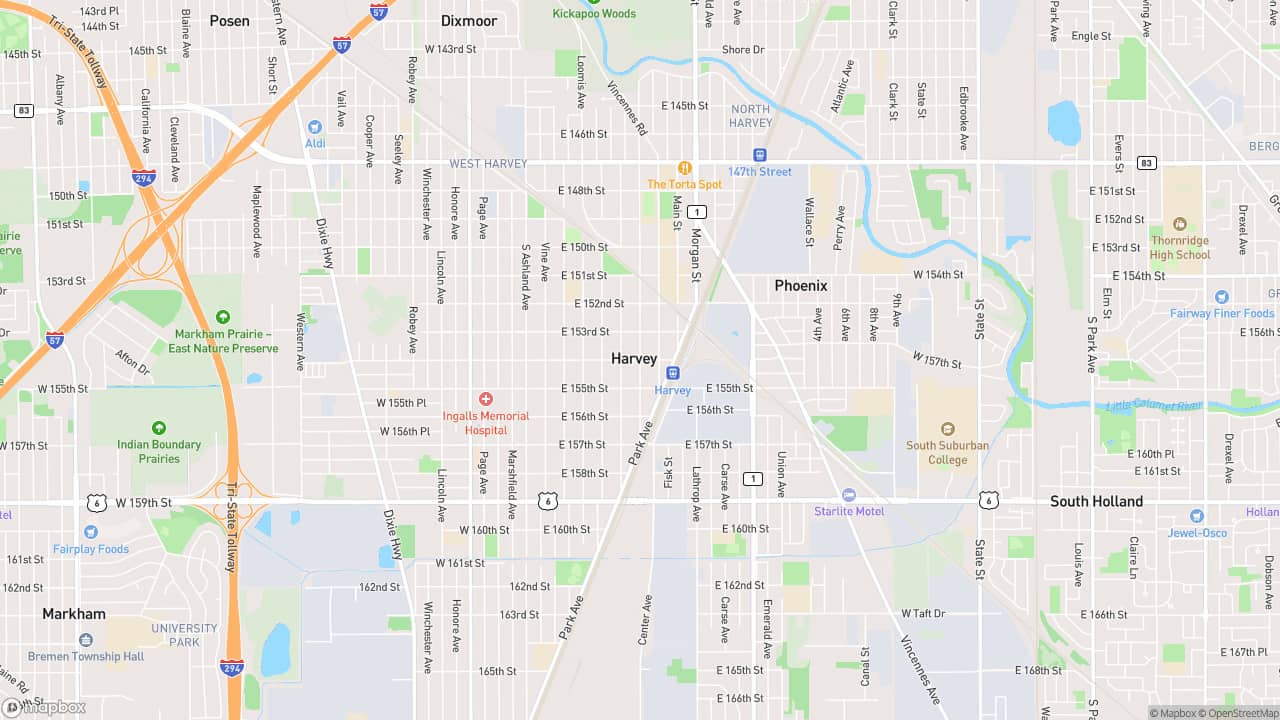
Harvey · Cook County · IL
Homes for sale in
Harvey.
- Active listings
- 57
- Median list
- $150K
- Avg time on market
- 29 days
- Sold · last year
- 122
Active listings
57 homes on the market


Be the first to know when a new Harvey home hits the market
Text + email the moment a new listing matches.
About the community
Living in Harvey.
Harvey is a city in Cook County, Illinois, in the south suburbs of Chicago, with a population of 20,324 at the 2020 census. It was founded in the early 1890s as a planned industrial and temperance town by businessman Turlington W. Harvey, who modeled it on the company town of Pullman. The town incorporated in 1890 and was elevated to city status by referendum in 1895. For most of its history heavy industry dominated the local economy, and Harvey grew into a blue-collar manufacturing hub before deindustrialization reshaped the city. Today Harvey is a major south-suburban transit point, served by Metra Electric commuter rail and the Pace Harvey Transportation Center. With a 2024 median property value of roughly $88,100, it remains one of the more affordable places to buy a home in Cook County.
At a glance
~20,300 residents
About 20,324 residents as of the 2020 census in south Cook County.
Metra Electric hub
Served by the Metra Electric line with the Harvey station at W. 154th St. and Park Ave.
Pace transit center
The Pace Harvey Transportation Center connects multiple south-suburban bus routes.
Planned industrial city
Founded in the early 1890s as a planned industrial and temperance town by Turlington W. Harvey.
District 152 and 205 schools
Harvey School District 152 serves K-8 and Thornton Township High School District 205 serves grades 9-12.
Ingalls Memorial Hospital
UChicago Medicine Ingalls Memorial Hospital is located in Harvey.
~$88,000 home values
A 2024 median property value of about $88,100, well below the national average.
Incorporated as a city 1895
Became a city by local referendum on April 15, 1895.
What’s close
Harvey sits in south Cook County roughly 20 miles south of downtown Chicago, anchored by Metra Electric rail, the Pace Harvey Transportation Center, and a major regional hospital.
- Metra Electric station
- Harvey station at W. 154th St. and Park Ave., on the Metra Electric line in fare zone 2.
- Pace Harvey Transportation Center
- A regional bus hub served by numerous Pace routes connecting the south suburbs.
- Ingalls Memorial Hospital
- UChicago Medicine Ingalls Memorial Hospital, part of the University of Chicago Medicine network.
- Major roads
- Halsted Street (Illinois Route 1) runs through the east side of town, and Dixie Highway runs through Harvey.
- Schools
- Harvey School District 152 for K-8 and Thornton Township High School District 205, whose Thornton Township High School is in Harvey.
- Township
- Harvey lies primarily in Thornton Township within Cook County.
What it’s actually like to live here
Housing in Harvey is among the most affordable in Cook County. The 2024 median property value was about $88,100, roughly a quarter of the national median, and the homeownership rate was 57.6 percent. The city's housing stock is largely older single-family homes from its industrial-era growth, and median household income was about $42,429 in 2024. For buyers and investors priced out of closer-in Chicago neighborhoods, Harvey can offer a low entry point, balanced against south Cook County's high effective property tax rates.
Harvey's biggest practical advantage is transit. The Metra Electric line gives residents a direct commuter-rail connection toward downtown Chicago's Millennium Station, and the Pace Harvey Transportation Center ties together numerous suburban bus routes. About 9.4 percent of Harvey workers commute by public transit, above the typical suburban share, and the average commute time is around 30 minutes. UChicago Medicine Ingalls Memorial Hospital is a significant local employer and anchor institution, and the city has pursued redevelopment efforts over the years amid broader retail and fiscal challenges.
Neighborhoods
Detailed Harvey community pages coming soon.
Browse the listings above. Detailed neighborhood pages with market stats, school info, and lifestyle take-downs land here as we roll them out.
Schools
Districts serving Harvey.
Boundary lines do shift. Always confirm in writing for a specific address before writing an offer.
- D152Grades K-8
Harvey School District 152
Schools serving the area
- Bryant Elementary School
- Riverdale Elementary School
- Whittier Elementary School
- Holmes Elementary School
Covers most of Harvey at the elementary level. A portion of the city falls within Posen-Robbins SD 143.5 and a portion within Dolton-Riverdale SD 148. Confirm per address.
- D147Grades K-8
West Harvey-Dixmoor Public School District 147
Schools serving the area
- Gwendolyn Brooks Elementary School
- Sandburg Elementary School
Serves the West Harvey and Dixmoor areas, with the district office in Dixmoor.
- D205Grades 9-12
Thornton Township High School District 205
Schools serving the area
- Thornton Township High School (Harvey)
- Thornridge High School (Dolton)
- Thornwood High School (South Holland)
Serves much of Cook County's Thornton Township, including Harvey. The Posen-Robbins portion of Harvey is part of Bremen High School District 228.
Homes by school
Homes for sale by school in Harvey
Around town
What there is to do in Harvey.
A handful of the places people who live here actually use. Not a directory.
- Family
Pace Harvey Transportation Center
Regional bus hub connecting Harvey to neighboring south suburbs, adjacent to the Metra Electric Harvey station.
- Culture
Harvey Public Library District
A community library serving Harvey for more than 120 years, at 15441 Turlington Avenue, with books, media, and free online resources.
- Parks
Forest Preserves of Cook County
Nearly 70,000 acres of woodlands, prairies, and trails across Cook County, with preserves accessible from the south suburbs.
- Family
UChicago Medicine Ingalls Memorial Hospital
Harvey's anchor hospital and a University of Chicago Medicine campus offering comprehensive care.
- Culture
Metra Electric Line
Commuter rail from Harvey toward downtown Chicago, a quick way to reach the Loop's museums, theaters, and lakefront.
- Culture
Millennium Station
The downtown Chicago terminal of the Metra Electric line, steps from Millennium Park, the Art Institute, and the lakefront.
Getting around
Commute + transit from Harvey.
- Stations: Harvey
- Terminal: Millennium Station
- Distance: 23 miles to downtown Chicago
- Routes: Halsted Street (IL Route 1) · Dixie Highway
By the numbers
Harvey taxes + market stats.
Property tax rates vary by exact township and assessor district. Confirm per address before pricing a purchase.
Property tax rate
6.86%
effective avg
Sales tax
10.50%
combined
Median sold price
$117,500
MRED · last 12 mo (122 sales)
Median household income
$42,429
ACS
How Harvey got here
A bit of history.
The land that became Harvey traces to an 1871 to 1872 syndicate that platted the South Lawn community, and a railway grade built in 1874 for the Grand Trunk Western Railroad helped spur early industrial development. In 1889 Turlington W. Harvey, a Chicago lumber baron and close associate of evangelist Dwight Moody, made large land purchases that he transferred to the Harvey Land Association. On April 12, 1890, local voters incorporated the new town as one of the temperance towns, intended as a model community built on Christian values and patterned after the company town of Pullman. The town took the Harvey name to honor both Turlington Harvey and Harvey Hopkins, who had established the first significant local industry, a mowing machine factory, in 1880. The village was elevated to city status by referendum on April 15, 1895, and a public library was established in 1903.
Heavy industry dominated Harvey's economy for most of its history. Major employers included the Whiting Corporation, which operated in Harvey from 1894 until 2000 making cupola furnaces, overhead cranes, and locomotive repair equipment, along with American Stove, Bliss and Laughlin cold-rolled steel, Wyman-Gordon, and Allis-Chalmers, which had acquired the Buda Engine Company in 1953. Sinclair Oil opened a research laboratory in Harvey in 1948, and the city reached its peak population around 1980. Like other Rust Belt communities, Harvey was hit hard by deindustrialization and the restructuring of the steel and similar industries, which drove losses in jobs and population. The Dixie Square Mall, opened in 1966 and closed in 1978, became nationally known as the filming site of the car-chase scene in The Blues Brothers.
The questions buyers actually ask
Harvey FAQ
The questions I get most from buyers shopping Harvey. If yours isn't here, text 224-385-8779, same-day reply.
- What school districts serve Harvey, Illinois?
- Most of Harvey is served by Harvey School District 152 for elementary grades (K-8) and Thornton Township High School District 205 for high school, with Thornton Township High School located in Harvey. West Harvey-Dixmoor School District 147 serves western Harvey and Dixmoor, and small portions of the city fall within other districts, so confirm per address.
- How do I commute from Harvey to downtown Chicago?
- Harvey is on the Metra Electric line, with the Harvey station at W. 154th St. and Park Ave. providing commuter rail service toward Millennium Station in downtown Chicago, roughly 23 miles away. The Pace Harvey Transportation Center also connects multiple suburban bus routes.
- Are property taxes high in Harvey?
- Yes. Harvey, like much of south Cook County, has high effective property tax rates. Ownwell reports an effective property tax rate of about 6.86 percent, well above national norms, though because home values are low the actual median bill is more modest. Always confirm the actual bill for a specific address.
- How affordable are homes in Harvey?
- Harvey is one of the more affordable places to buy in Cook County. The 2024 median property value was about $88,100, roughly a quarter of the national median, with a homeownership rate of 57.6 percent.
- What is the history of Harvey, Illinois?
- Harvey was founded in the early 1890s as a planned industrial and temperance town by businessman Turlington W. Harvey, modeled on the company town of Pullman. It incorporated in 1890 and became a city by referendum in 1895, then grew into a major manufacturing center before deindustrialization in the late 20th century.
- What is the sales tax rate in Harvey?
- The combined 2026 sales tax rate in Harvey is 10.5 percent, made up of 6.25 percent Illinois state tax, 1.75 percent Cook County tax, 1.5 percent Harvey city tax, and 1 percent RTA transit tax.
- What makes Harvey distinct among Chicago's south suburbs?
- Harvey stands out as a historic planned industrial city and a major south-suburban transit hub, combining Metra Electric commuter rail, the Pace Harvey Transportation Center, and UChicago Medicine Ingalls Memorial Hospital with some of the most affordable home prices in Cook County.
- Who is the real estate agent for Harvey?
- Joe Keegan is the local licensed Illinois real estate broker who covers Harvey in Harvey, IL through Subdiview, a neighborhood-first home search for the Chicago suburbs and collar counties. Joe prices and negotiates from the live MRED sold comps for Harvey specifically, not national averages, and can help you buy or sell here. Reach Joe at 224-385-8779 or joe@joekeeganhomes.com.
Nearby
Towns next to Harvey.
If you’re cross-shopping the area, these are the places that border Harvey.
Your local agent
Joe knows Harvey
Most agents will list anything. I focus on the places I actually know, and the things that move value here don't show up in the MLS write-up: which streets and buildings hold demand, what the HOA or assessments really cover, how the comps read once you account for condition and location, and where buyers consistently want to be.
When you're ready to tour or list, you want someone who has read the last 50 closed comps in this specific market, not a national average, and can tell you what they actually mean for your price. That's how I work. Text or call any time, and I'll give you a real take, not a brochure.
- Licensed Illinois broker
- Comp-driven pricing
- Harvey specialist
- Honest local market take
- Brokerocity
Thinking of selling?
What's your home actually worth?
Not a Zestimate. A real CMA from someone who's sold this neighborhood, knows the floor plan premiums, and can tell you which upgrades the buyer pool here actually pays for.
- Pricing range with comp-by-comp logic
- Pre-list improvements that pay back, and the ones that don't
- No obligation, no spam, no auto-dialer