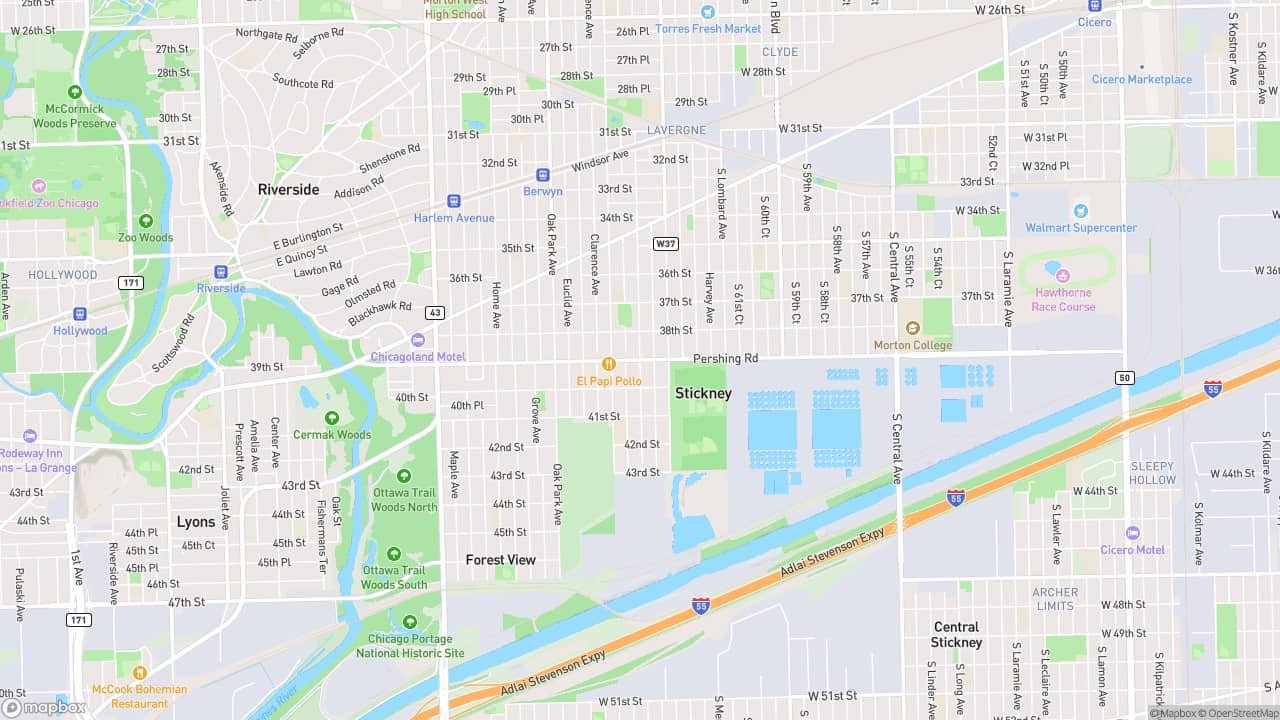
Stickney · Cook County · IL
Homes for sale in
Stickney.
- Active listings
- 9
- Median list
- $350K
- Avg time on market
- 29 days
- Sold · last year
- 52
Active listings
9 homes on the market


Be the first to know when a new Stickney home hits the market
Text + email the moment a new listing matches.
About the community
Living in Stickney.
Stickney is a small village in Cook County, Illinois, about 8 miles southwest of downtown Chicago, with a 2020 census population of 7,110 packed into under two square miles. It is named for Alpheus Beede Stickney, a railroad executive who helped establish the Clearing Industrial District. Much of its land was reclaimed from Mud Lake, a marshy area that dried out as the Illinois and Michigan Canal and later the Sanitary and Ship Canal drained it, after which German and Dutch farmers settled the area. The village is well known for hosting the Metropolitan Water Reclamation District's Stickney plant, one of the largest sewage treatment plants in the world, which occupies a large share of the village and is its biggest employer. Commuters benefit from immediate access to Interstate 55, the Stevenson Expressway, which runs along the northern edge of the township. The residential heart of town sits in the western end, away from the industrial east, and homeownership runs above 80 percent. With a median home value around $244,900 and a strong owner-occupied base, Stickney remains an affordable, stable community relative to Cook County as a whole.
At a glance
About 7,110 residents
Stickney's 2020 census population was 7,110, in a village under two square miles.
Incorporated in 1913
The village was established from Stickney Township land in 1913, with the township itself organized in 1901.
Named for a railroad man
Stickney honors Alpheus Beede Stickney, the railroad executive behind the Clearing Industrial District.
Strong homeownership
As of 2024 about 83 percent of housing units were owner-occupied, well above the national average.
Affordable home values
The median property value was about $244,900, below the national average.
Stevenson Expressway access
Interstate 55 runs along the northern edge of the township, giving residents quick access toward the Loop or the southwest suburbs.
Diverse community
About three quarters of residents identify as Hispanic, the largest demographic group in the village.
World-class water plant
The MWRD Stickney Water Reclamation Plant, one of the largest in the world, sits in the village and is its biggest employer.
What’s close
Stickney lies about 8 miles southwest of downtown Chicago, bordered by Berwyn and Cicero to the north and its small neighbor Forest View, with Interstate 55 running along the northern edge of the township.
- Interstate 55 / Stevenson Expressway
- Forms part of the northern boundary of Stickney Township, giving residents quick highway access toward the Loop or the southwest suburbs.
- MWRD Stickney Water Reclamation Plant
- One of the largest sewage treatment plants in the world, operated by the Metropolitan Water Reclamation District of Greater Chicago, occupying a large share of the village.
- Mount Auburn Cemetery
- A spacious cemetery founded in 1895, historically tied to the village's early days.
- Harlem Avenue (IL 43)
- A major north-south arterial running along the west side of the area, connecting Stickney to Riverside, Berwyn, and Bedford Park.
- Pershing Road corridor
- The northern boundary of Stickney Township and the location of Stickney's Village Hall on Pershing Road.
- Western residential core
- The village's homes are concentrated in the western end of town, the quieter residential heart away from the industrial east.
What it’s actually like to live here
Stickney is a compact, owner-occupied village where homeownership runs above 80 percent and the housing stock skews toward the modest single-family homes built when construction peaked in the 1950s. The median home value, around $244,900, sits below the national average, making it an affordable foothold in near-southwest Cook County. The residential area concentrates in the western end of town, away from the industrial east and the treatment plant, where streets are quiet and neighbor ties are close. The community is diverse, with about three quarters of residents identifying as Hispanic and a notable foreign-born population.
Day-to-day life leans on the car, with most workers driving and an average commute around 26 minutes. For recreation, the village maintains several recreation areas including O'Reilly Park, Haley Park, and Veterans Memorial Park, plus the Bruscato Dog Park, an enclosed off-leash facility. Haley Park sits on the former site of Haley School, which was demolished in 1987 and converted to parkland in 1989. The village also collaborates with neighboring Forest View, including on the shared Stickney-Forest View Library District formed in 1953.
Neighborhoods
Detailed Stickney community pages coming soon.
Browse the listings above. Detailed neighborhood pages with market stats, school info, and lifestyle take-downs land here as we roll them out.
Schools
Districts serving Stickney.
Boundary lines do shift. Always confirm in writing for a specific address before writing an offer.
- SD103Grades Pre-K - 8
Lyons Elementary School District 103
Schools serving the area
- Home Elementary School
- Edison Elementary School
- George Washington Middle School (Lyons)
Stickney's public elementary schools, Home and Edison, are part of Lyons Elementary School District 103, after which students attend George Washington Middle School in Lyons. Boundaries vary by address, so confirm the assigned school for any specific property.
- D201Grades 9 - 12
J. Sterling Morton High School District 201
Schools serving the area
- Morton West High School (Berwyn)
- Morton East High School (Cicero)
Stickney teens generally attend Morton West High School in Berwyn. Attendance zones can change, so always confirm the assigned high school for a specific address with District 201.
Around town
What there is to do in Stickney.
A handful of the places people who live here actually use. Not a directory.
- Parks
O'Reilly Park
One of the village's recreation areas, offering neighborhood green space and play areas for residents.
- Parks
Haley Park
A village park created in 1989 on the former site of Haley School, providing open recreation space in the residential west end.
- Family
Bruscato Dog Park
An enclosed off-leash dog facility with affordable resident annual permits, open sunrise to sunset.
- Parks
Veterans Memorial Park
A village park honoring veterans, with a memorial engraving program for the community.
- Culture
Stickney-Forest View Public Library
The shared library district serving Stickney and Forest View, formed in 1953, a community resource for both villages.
- Family
Village of Stickney Youth Sports
The village organizes youth sports programs and community recreation through its Parks and Recreation department.
Getting around
Commute + transit from Stickney.
- Routes: I-55 (Stevenson Expressway) · Harlem Avenue (IL 43) · Pershing Road · Cicero Avenue
- O'Hare Airport: ~30 min
- Chicago Loop: ~26 min
By the numbers
Stickney taxes + market stats.
Property tax rates vary by exact township and assessor district. Confirm per address before pricing a purchase.
Property tax rate
2.67%
effective avg
Sales tax
10.25%
combined
Median sold price
$317,500
MRED · last 12 mo (52 sales)
Median household income
$66,942
ACS
How Stickney got here
A bit of history.
Until about 1900, most of what is now Stickney was covered by Mud Lake, a large marsh stretching from Chicago to Lyons and crossed by a historic portage trail between the Chicago and Des Plaines rivers. Mud Lake began receding after the Illinois and Michigan Canal was built in 1836, and by 1900 the Sanitary and Ship Canal had left it relatively dry, prompting developers to build on the reclaimed land with early German and Dutch farmer residents. The village is named for Alpheus B. Stickney, a railroad executive central to creating the Clearing Industrial District. Stickney Township was organized in 1901, and in 1913 the village of Stickney was established from township land.
As neighboring Cicero and Berwyn boomed in the 1920s, Stickney grew too, but the era also brought Al Capone and other criminals who set up brothels and speakeasies around 1920, with illegal gambling persisting into at least the 1950s. By the late 1930s the population was about 2,000, growing to 6,239 by 1960 as postwar home construction peaked in the 1950s and the residential area concentrated in the western end of town. In 1949 Commonwealth Edison began building a coal-fired power plant straddling Stickney and Forest View, and the two villages later jointly formed the Stickney-Forest View Library District in 1953. The Metropolitan Water Reclamation District's Stickney treatment plant, opened in phases since 1930, is the largest of its kind in the world and remains the village's largest employer.
The questions buyers actually ask
Stickney FAQ
The questions I get most from buyers shopping Stickney. If yours isn't here, text 224-385-8779, same-day reply.
- What schools serve Stickney?
- Stickney's public elementary schools, Home and Edison, are part of Lyons Elementary School District 103, after which students attend George Washington Middle School in Lyons. High schoolers attend Morton West High School in Berwyn, part of J. Sterling Morton High School District 201. Boundaries vary by address, so confirm the assigned schools before writing an offer.
- What is the commute to Chicago like from Stickney?
- Stickney is about 8 miles southwest of the Loop, and the average resident commute is roughly 26 minutes. Most residents drive, with Interstate 55, the Stevenson Expressway, providing direct highway access toward downtown.
- Is there a Metra station in Stickney?
- No, there is no Metra station within the village. The nearest service is on the BNSF Line in neighboring Berwyn, including the La Vergne, Berwyn, and Harlem Avenue stations just to the north.
- What are property taxes like in Stickney?
- Stickney's median effective property tax rate runs around 2.67 percent, which is typical for Cook County and higher than the Illinois state median. Always confirm by pulling the actual tax bill for the specific address, since exemptions and assessments vary.
- How much do homes cost in Stickney?
- The median property value was about $244,900, below the national average, and more than 80 percent of homes are owner-occupied. That makes Stickney one of the more affordable owner-occupied communities in near-southwest Cook County.
- What is Stickney known for?
- Stickney is known for hosting one of the world's largest sewage treatment plants, the MWRD Stickney Water Reclamation Plant, and historically for its Prohibition-era ties to Al Capone's brothels and speakeasies in the 1920s.
- Who is the real estate agent for Stickney?
- Joe Keegan is the local licensed Illinois real estate broker who covers Stickney in Stickney, IL through Subdiview, a neighborhood-first home search for the Chicago suburbs and collar counties. Joe prices and negotiates from the live MRED sold comps for Stickney specifically, not national averages, and can help you buy or sell here. Reach Joe at 224-385-8779 or joe@joekeeganhomes.com.
Nearby
Towns next to Stickney.
If you’re cross-shopping the area, these are the places that border Stickney.
Your local agent
Joe knows Stickney
Most agents will list anything. I focus on the places I actually know, and the things that move value here don't show up in the MLS write-up: which streets and buildings hold demand, what the HOA or assessments really cover, how the comps read once you account for condition and location, and where buyers consistently want to be.
When you're ready to tour or list, you want someone who has read the last 50 closed comps in this specific market, not a national average, and can tell you what they actually mean for your price. That's how I work. Text or call any time, and I'll give you a real take, not a brochure.
- Licensed Illinois broker
- Comp-driven pricing
- Stickney specialist
- Honest local market take
- Brokerocity
Thinking of selling?
What's your home actually worth?
Not a Zestimate. A real CMA from someone who's sold this neighborhood, knows the floor plan premiums, and can tell you which upgrades the buyer pool here actually pays for.
- Pricing range with comp-by-comp logic
- Pre-list improvements that pay back, and the ones that don't
- No obligation, no spam, no auto-dialer