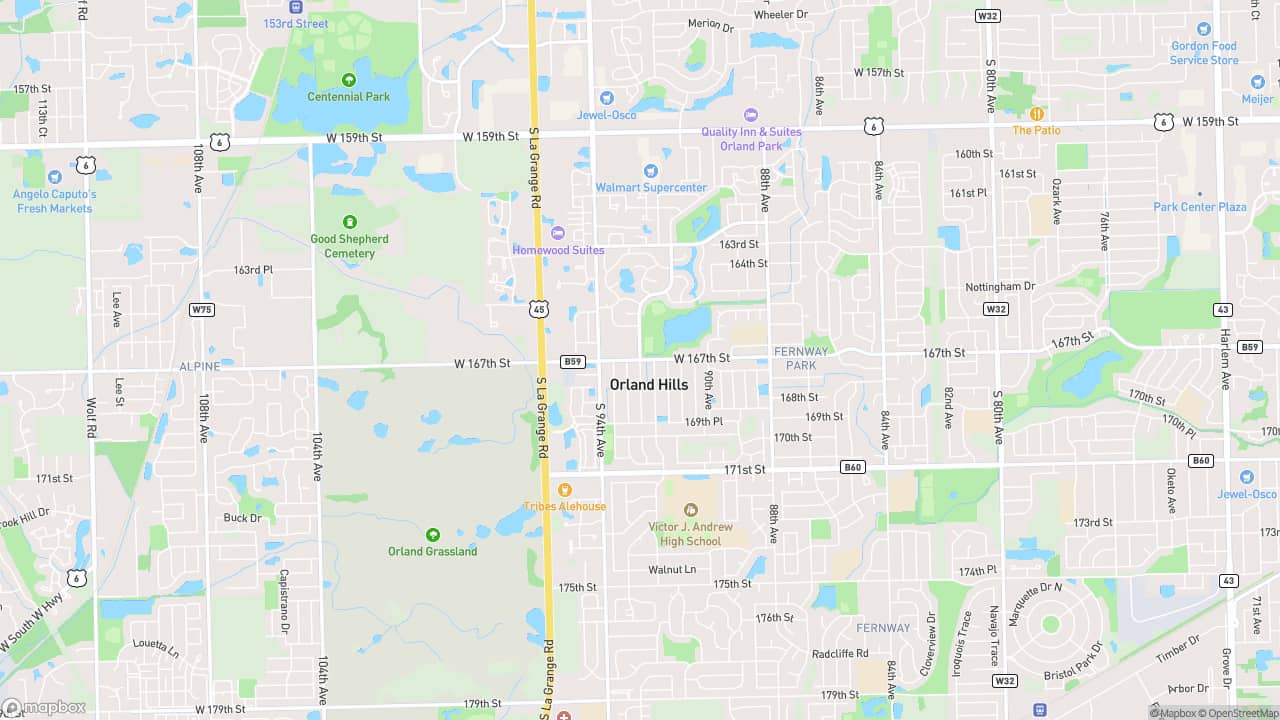
Orland Hills · Cook County · IL
Homes for sale in
Orland Hills.
- Active listings
- 6
- Median list
- $402K
- Avg time on market
- 7 days
- Sold · last year
- 61
Active listings
6 homes on the market


Be the first to know when a new Orland Hills home hits the market
Text + email the moment a new listing matches.
About the community
Living in Orland Hills.
Orland Hills is a compact village of about 6,893 residents in Orland Township in southwest Cook County, Illinois, covering just over one square mile of land. Incorporated on June 30, 1961 under the name Westhaven, the community was renamed Orland Hills in April 1986. It is a tightly knit, family-oriented community of single-family subdivisions, with an average household size of roughly 3.5 people. The village sits directly between Orland Park to the north and west and Tinley Park to the south and east, giving residents quick access to the retail, dining, and employment of both larger suburbs. While Orland Hills has no Metra station of its own, the Metra SouthWest Service stations in neighboring Orland Park put downtown Chicago commuter rail within a short drive. Local children are served by Kirby School District 140 and Orland School District 135 for the elementary grades, and by Consolidated High School District 230 for high school.
At a glance
~6,893 residents
One of the smaller villages in southwest Cook County, 6,893 at the 2020 census.
Small footprint
The village covers just 1.15 square miles, almost entirely built out with residential neighborhoods.
Elementary schools
Served by Kirby School District 140 and Orland School District 135 for preschool through eighth grade.
High schools
Part of Consolidated High School District 230, with students attending Victor J. Andrew or Carl Sandburg High School depending on location.
Metra access nearby
The Metra SouthWest Service stations in neighboring Orland Park provide commuter rail to downtown Chicago.
Median home value ~$334k
The typical home value was about $333,920 in spring 2026, up nearly 6 percent year over year.
Median income ~$122k
The median household income reached about $122,039 in 2024.
Property taxes
The median effective property tax rate is about 2.82 percent, with a median annual bill near $5,500.
What’s close
Orland Hills is compact and surrounded by Orland Park and Tinley Park, so residents reach regional retail, parks, and the nearest Metra stations within minutes.
- Nearest Metra station
- The Metra SouthWest Service stations at 179th Street and 153rd Street in Orland Park are the closest commuter rail, a short drive away.
- Major roads
- Key local arterials include 159th Street, 167th Street, and 94th Avenue, with US Route 45 (La Grange Road) just west of the village.
- Retail nearby
- Orland Square Mall and the extensive retail corridor along La Grange Road in adjacent Orland Park are minutes away.
- Village parks
- Orland Hills maintains local parks including Richard F. Kelly Park along with Lake Ashbourne and Lake Lorin.
- Neighbors
- The village is bordered by Orland Park to the north and west and Tinley Park to the south and east.
- Pace bus
- Pace provides bus service on Route 364, connecting Orland Hills to destinations across the Chicago Southland.
What it’s actually like to live here
Life in Orland Hills centers on its dense, well-kept single-family subdivisions, where homeownership is the norm and the average household runs to about three and a half people. With roughly 63 percent of households being married couples and a median age in the mid-30s, the village has a distinctly family-oriented, settled feel. Neighborhoods such as Pepperwood, Westwood, and Green Acres were master-planned, and the village maintains parks, two lakes, and a community center for residents.
Because Orland Hills is so compact and surrounded by Orland Park and Tinley Park, residents enjoy the amenities of much larger suburbs without leaving the immediate area. The retail, dining, and entertainment hub anchored by Orland Square Mall and the La Grange Road corridor sits just minutes north in Orland Park. The surrounding area also offers extensive Cook County Forest Preserve land and large municipal parks, including Orland Park's Centennial Park, all within a short drive. The combination of affordable family housing, strong schools, and easy access to regional shopping and Metra commuter rail gives the village its appeal.
Neighborhoods
Detailed Orland Hills community pages coming soon.
Browse the listings above. Detailed neighborhood pages with market stats, school info, and lifestyle take-downs land here as we roll them out.
Schools
Districts serving Orland Hills.
Boundary lines do shift. Always confirm in writing for a specific address before writing an offer.
- D140Grades Pre-K-8
Kirby School District 140
Schools serving the area
- Kruse Education Center
- Fierke Education Center
- Grissom Elementary
- Meadow Ridge School
An elementary district serving Tinley Park, Orland Hills, and Orland Park across about 12 square miles. One of two elementary districts serving Orland Hills. Verify by address.
- D135Grades Pre-K-8
Orland School District 135
Schools serving the area
- Liberty Elementary
- Jerling Junior High School
The second of the two elementary districts covering portions of Orland Hills, alongside Kirby 140. Verify by address.
- D230Grades 9-12
Consolidated High School District 230
Schools serving the area
- Victor J. Andrew High School
- Carl Sandburg High School
Orland Hills students attend Victor J. Andrew High School if they live south of Meadowview Avenue, or Carl Sandburg High School if north of it.
Around town
What there is to do in Orland Hills.
A handful of the places people who live here actually use. Not a directory.
- Parks
Orland Hills Recreation Department
The village's recreation department runs programs, leagues, and events out of the community center and local parks.
- Family
Orland Square Mall
A large enclosed shopping mall in adjacent Orland Park with anchor department stores and dozens of shops minutes from the village.
- Parks
Centennial Park (Orland Park)
A nearby Orland Park flagship park featuring a lake, aquatic center, and sports fields, a short drive from Orland Hills.
- Parks
Richard F. Kelly Park
A five-acre village park set aside during the community's 1970s development, with open space and a man-made lake.
- Parks
Orland Grassland
A large Cook County forest preserve in nearby Orland Park with miles of trails, prairie, and wetland for hiking and biking.
- Parks
Cook County Forest Preserves
The forest preserve district maintains natural trails, woods, and picnic areas across the southwest suburbs surrounding Orland Hills.
Getting around
Commute + transit from Orland Hills.
- Routes: 159th Street · 167th Street · 94th Avenue · US 45 (La Grange Road)
- O'Hare Airport: ~53 min
- Chicago Loop: ~75 min
By the numbers
Orland Hills taxes + market stats.
Property tax rates vary by exact township and assessor district. Confirm per address before pricing a purchase.
Property tax rate
2.82%
effective avg
Sales tax
10.00%
combined
Median sold price
$340,000
MRED · last 12 mo (61 sales)
Median household income
$122,039
ACS
How Orland Hills got here
A bit of history.
Orland Hills traces its origins to the Village of Westhaven, which was incorporated on June 30, 1961. At incorporation its boundaries ran from 167th Street on the north to 169th Street on the south, and from 94th Avenue on the west to 90th Avenue on the east, and the first village board met on August 3, 1961 with President Raymond Pecor presiding. Through the 1960s and early 1970s the young village expanded through a series of annexations, reaching north to 159th Street and south to 171st Street, and in 1974 the first single-family housing development arrived, which also set aside open land for stormwater storage, a man-made lake, and the five acres that became Richard F. Kelly Park.
Rapid residential growth defined the late 1970s and 1980s. A special census in 1978 counted just 2,034 residents, but new subdivisions such as Green Acres, Park View, and Westwood pushed the population to roughly 2,703 by 1980 and to just under 5,000 by the mid-1980s. In April 1986, the village board passed an ordinance changing the community's name from Westhaven to Orland Hills. Development continued through the 1990s and 2000s with subdivisions like Pepperwood, which added about 330 homes beginning in 1996, and the Liberty Square condominiums beginning in 2002, cementing the village's character as a planned, residential community.
The questions buyers actually ask
Orland Hills FAQ
The questions I get most from buyers shopping Orland Hills. If yours isn't here, text 224-385-8779, same-day reply.
- Is there a Metra station in Orland Hills?
- No, Orland Hills does not have its own Metra station, but you are not far from one. The Metra SouthWest Service stations at 179th Street and 153rd Street in neighboring Orland Park are just a short drive away and run directly into Chicago Union Station.
- How is the commute to downtown Chicago?
- Most residents drive or combine a short drive with the Metra SouthWest Service from Orland Park. By car, downtown Chicago is roughly 49 miles, about an hour and 15 minutes in typical traffic, while O'Hare is closer to 31 miles. Pace Route 364 also serves the village for local connections.
- What do homes cost in Orland Hills?
- As of spring 2026, the typical home value in Orland Hills is about $333,920, up nearly 6 percent over the prior year, which keeps it among the more affordable family-housing markets in the Orland Park and Tinley Park area.
- What are the property taxes like?
- Like much of southern Cook County, Orland Hills carries a relatively high effective property tax rate of about 2.82 percent, with a median annual tax bill near $5,500. Always confirm the exact bill for a specific property.
- What schools serve Orland Hills?
- Elementary students attend schools in Kirby School District 140 or Orland School District 135, both covering preschool through eighth grade. For high school, the village is part of Consolidated High School District 230, with students attending either Victor J. Andrew High School or Carl Sandburg High School depending on where in the village they live.
- How is Orland Hills related to Orland Park?
- Orland Hills is a separate, much smaller village that sits between Orland Park and Tinley Park, with Orland Park wrapping around it on the north and west. While the two are distinct municipalities, Orland Hills residents rely heavily on Orland Park's retail, including Orland Square Mall, and share elementary school districts and the nearest Metra stations.
- Was Orland Hills always called Orland Hills?
- No. The village was incorporated in 1961 as Westhaven and kept that name for 25 years, before the village board officially renamed it Orland Hills in April 1986.
- Who is the real estate agent for Orland Hills?
- Joe Keegan is the local licensed Illinois real estate broker who covers Orland Hills in Orland Hills, IL through Subdiview, a neighborhood-first home search for the Chicago suburbs and collar counties. Joe prices and negotiates from the live MRED sold comps for Orland Hills specifically, not national averages, and can help you buy or sell here. Reach Joe at 224-385-8779 or joe@joekeeganhomes.com.
Nearby
Towns next to Orland Hills.
If you’re cross-shopping the area, these are the places that border Orland Hills.
Your local agent
Joe knows Orland Hills
Most agents will list anything. I focus on the places I actually know, and the things that move value here don't show up in the MLS write-up: which streets and buildings hold demand, what the HOA or assessments really cover, how the comps read once you account for condition and location, and where buyers consistently want to be.
When you're ready to tour or list, you want someone who has read the last 50 closed comps in this specific market, not a national average, and can tell you what they actually mean for your price. That's how I work. Text or call any time, and I'll give you a real take, not a brochure.
- Licensed Illinois broker
- Comp-driven pricing
- Orland Hills specialist
- Honest local market take
- Brokerocity
Thinking of selling?
What's your home actually worth?
Not a Zestimate. A real CMA from someone who's sold this neighborhood, knows the floor plan premiums, and can tell you which upgrades the buyer pool here actually pays for.
- Pricing range with comp-by-comp logic
- Pre-list improvements that pay back, and the ones that don't
- No obligation, no spam, no auto-dialer