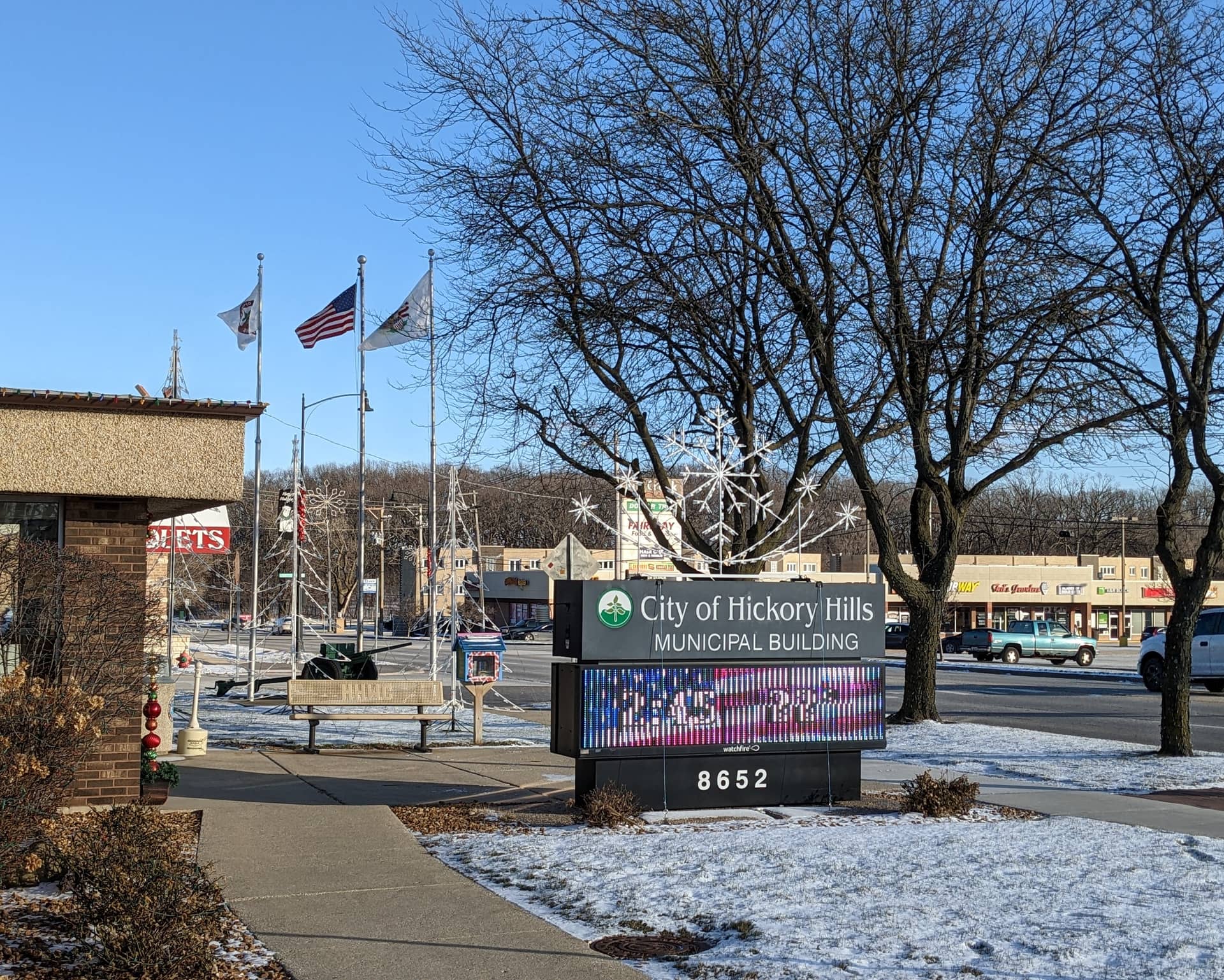
Hickory Hills · Cook County · IL
Homes for sale in
Hickory Hills.
- Active listings
- 46
- Median list
- $400K
- Avg time on market
- 31 days
- Sold · last year
- 119
Active listings
46 homes on the market


Be the first to know when a new Hickory Hills home hits the market
Text + email the moment a new listing matches.
About the community
Living in Hickory Hills.
Hickory Hills is a city of 14,505 residents at the 2020 census in Cook County, Illinois, located roughly 18 to 22 miles southwest of downtown Chicago. The community sits on the relatively hilly Tinley Moraine, a belt of glacial ridges laid down about 14,000 years ago, which gives the city its wooded, rolling character. It is bounded on the west by the Palos Forest Preserves nature reserve and on the east by the Tri-State Tollway (Interstate 294). The city's main east-west thoroughfares are 87th Street and 95th Street, the latter carrying U.S. Route 12 and U.S. Route 20. Hickory Hills has a notably diverse heritage, with Polish, Arab, Irish, and Lithuanian among the most commonly reported ancestries.
At a glance
~14,505 residents
About 14,505 residents as of the 2020 census in southwest Cook County.
On the Tinley Moraine
Sits on hilly glacial ridges roughly 14,000 years old, giving the city its wooded, rolling terrain.
Palos Forest Preserves
Bordered on the west by the expansive Palos Forest Preserves nature reserve.
I-294 on the east edge
The Tri-State Tollway forms the city's eastern boundary; 95th Street carries U.S. Routes 12 and 20.
Hickory Hills Country Club
A historic club founded in 1917, with a course originally designed by James Foulis.
~$260,000 home values
A median home value of about $260,000 as of 2026, per Ownwell.
City since 1966
Incorporated as a village in 1951 and reorganized as a city by referendum in 1966.
Diverse heritage
Top reported ancestries include Polish, Arab, Irish, and Lithuanian.
What’s close
Hickory Hills is positioned in southwest Cook County, hemmed by the Palos Forest Preserves to the west and Interstate 294 to the east, giving residents both a wooded setting and fast highway access toward Chicago and the Southland.
- Major roads
- 95th Street (U.S. Routes 12 and 20) and 87th Street are the main east-west thoroughfares; Interstate 294 forms the eastern edge.
- Transit
- Pace provides bus service on routes 379, 381, and 385 connecting the city across the Chicago Southland; there is no Metra station within the city.
- Schools
- Served by North Palos School District 117 and Indian Springs District 109 for K-8, with high schoolers attending Stagg High School (District 230) or Argo Community High School.
- Township
- Located mostly in Palos Township, with the portion north of 87th Street in Lyons Township.
- Landmarks
- Hickory Hills Country Club (1917) and the adjacent Palos Forest Preserves are signature features.
- Higher education
- Residents fall within the Moraine Valley Community College district (District 524).
What it’s actually like to live here
Hickory Hills offers a relatively affordable entry point into Cook County's southwest suburbs, with a median home value of about $260,000 as of 2026, below the typical Chicago-area benchmark. The housing stock is dominated by established single-family homes set on the area's wooded, rolling terrain, with 5,342 households recorded in the 2020 census and a homeowner vacancy rate of just 1.2 percent, signaling a stable, owner-occupied market. The median household income was about $77,262 in 2024.
Commuting is straightforward, with Interstate 294 along the eastern border and Pace bus routes 379, 381, and 385 linking the city to the broader Southland; the drive to downtown Chicago runs roughly 18 to 22 miles. Day-to-day amenities cluster along the 95th Street corridor, and residents enjoy the Hickory Hills Park District's facilities along with the vast Palos Forest Preserves on the city's western flank. One affordability tradeoff is the property tax burden: the median effective rate is about 2.67 percent, higher than both the Cook County and Illinois medians.
Neighborhoods
Detailed Hickory Hills community pages coming soon.
Browse the listings above. Detailed neighborhood pages with market stats, school info, and lifestyle take-downs land here as we roll them out.
Schools
Districts serving Hickory Hills.
Boundary lines do shift. Always confirm in writing for a specific address before writing an offer.
- D117Grades Pre-K-8
North Palos School District 117
Schools serving the area
- Serves Hickory Hills K-8 students; feeds into Amos Alonzo Stagg High School
Covers much of Hickory Hills. District 117 students feed into Stagg High School (District 230). Confirm per address.
- D109Grades Pre-K-8
Indian Springs School District 109
Schools serving the area
- Serves part of Hickory Hills K-8; feeds into Argo Community High School
Serves the part of Hickory Hills not in District 117 and feeds into Argo Community High School.
- D230Grades 9-12
Consolidated High School District 230
Schools serving the area
- Amos Alonzo Stagg High School (Palos Hills)
District 117 zone students attend Stagg High School; District 109 zone students instead attend Argo Community High School.
Homes by school
Homes for sale by school in Hickory Hills
Around town
What there is to do in Hickory Hills.
A handful of the places people who live here actually use. Not a directory.
- Parks
Kasey Meadow Park
A 17-acre Hickory Hills Park District flagship with a splash pad, a sledding hill, a half-mile track, basketball courts, baseball diamonds, playgrounds, and free summer concerts.
- Family
Krueger Park Recreation Center
A park district recreation hub with an indoor gym and walking track, a fitness room, a sand volleyball court, tennis courts, and a rentable community room.
- Culture
Hickory Hills Country Club
A historic country club founded in 1917 with an 18-hole course originally designed by James Foulis plus a 9-hole executive course at 8201 W. 95th Street.
- Parks
Hickory Hills Woods
Part of the extensive Palos preserve system bordering the city, offering natural woodlands and trails for hiking and outdoor recreation.
- Culture
Green Hills Public Library District
The public library serving Hickory Hills and Palos Hills, located at 8652 W. 95th Street, with programs, resources, and community services.
- Food & Drink
Xando Cafe
A family-owned Hickory Hills restaurant and bar tradition since 1999, located at 8729 W. 95th Street.
Getting around
Commute + transit from Hickory Hills.
- Routes: 95th Street (U.S. 12 / U.S. 20) · 87th Street · I-294 (Tri-State Tollway)
- Chicago Loop: ~35 min
- O'Hare Airport: ~35 min
By the numbers
Hickory Hills taxes + market stats.
Property tax rates vary by exact township and assessor district. Confirm per address before pricing a purchase.
Property tax rate
2.67%
effective avg
Sales tax
10.00%
combined
Median sold price
$356,000
MRED · last 12 mo (119 sales)
Median household income
$77,262
ACS
How Hickory Hills got here
A bit of history.
The village of Hickory Hills was incorporated in September 1951, drawn from the territory between 91st and 95th streets and between 80th and 88th avenues, with roughly 600 residents at the time of incorporation. The Hickory Hills Country Club had already been established in the area in 1917, featuring an 18-hole golf course designed by Scottish-American golfer James Foulis, and that club still operates today. Voters approved a change from village to city form of government in October 1966, a transition that coincided with infrastructure improvements such as sewer systems and a connection to Lake Michigan water.
The city's landscape is defined by the Tinley Moraine, a ridge belt formed about 14,000 years ago during the Wisconsin glaciation, which accounts for the area's hickory groves and hilly terrain. In 1961, the Poor Clares, a branch of the Franciscan order, acquired 20 acres at 89th Street and Keane Avenue to establish a monastery, though it closed in 1992 as numbers dwindled and the order eventually relocated to nearby Palos Park. Over the decades Hickory Hills grew into an established residential suburb, with its population climbing from about 13,926 in 2000 to 14,505 in 2020.
The questions buyers actually ask
Hickory Hills FAQ
The questions I get most from buyers shopping Hickory Hills. If yours isn't here, text 224-385-8779, same-day reply.
- What school districts serve Hickory Hills?
- Elementary and middle grade students attend either North Palos School District 117 or Indian Springs District 109, depending on where they live. For high school, District 117 zone students attend Amos Alonzo Stagg High School in Consolidated High School District 230, while District 109 zone students attend Argo Community High School. The city is also within the Moraine Valley Community College district. Confirm boundaries per address.
- How long is the commute to downtown Chicago?
- Hickory Hills sits roughly 18 to 22 miles southwest of the Chicago Loop, with drive times commonly around 30 to 35 minutes in light traffic. Interstate 294 borders the city to the east, and Pace bus routes 379, 381, and 385 provide transit connections, though there is no Metra station within the city itself.
- What are property taxes like in Hickory Hills?
- The median effective property tax rate is about 2.67 percent, which is higher than the Cook County median of about 2.14 percent and the Illinois median of about 2.33 percent. For a typical home, that translates to a median annual tax bill of around $6,709. Homeowners may qualify for homestead, senior, veteran, or disability exemptions that reduce the assessed value.
- Is Hickory Hills affordable for homebuyers?
- Hickory Hills is relatively affordable for the southwest suburbs, with a median home value of about $260,000 as of 2026. The housing market is predominantly owner-occupied single-family homes, with a very low homeowner vacancy rate of 1.2 percent reported in the 2020 census. Buyers should factor the above-average property tax rate into their budgeting.
- What is the history of Hickory Hills?
- Hickory Hills was incorporated as a village in September 1951 with about 600 residents, and voters approved its reorganization as a city in 1966. The Hickory Hills Country Club predates the city, having been founded in 1917 with a golf course designed by James Foulis. The city's distinctive hilly, wooded terrain comes from the Tinley Moraine, a glacial ridge belt formed roughly 14,000 years ago.
- What is there to do in Hickory Hills?
- The Hickory Hills Park District operates Kasey Meadow Park, with a splash pad, sledding hill, and free summer concerts, and the Krueger Park Recreation Center, with an indoor gym, fitness room, and courts. Outdoor enthusiasts can explore the adjacent Palos Forest Preserves and Hickory Hills Woods, and golfers can play the historic Hickory Hills Country Club. The Green Hills Public Library on 95th Street rounds out community amenities.
- What makes Hickory Hills distinctive?
- Hickory Hills stands out for its rolling, wooded terrain on the Tinley Moraine and its location directly bordering the expansive Palos Forest Preserves. It also has a notably diverse heritage, with Polish, Arab, Irish, and Lithuanian among the most commonly reported ancestries, and the historic Hickory Hills Country Club, dating to 1917, remains a community landmark.
- Who is the real estate agent for Hickory Hills?
- Joe Keegan is the local licensed Illinois real estate broker who covers Hickory Hills in Hickory Hills, IL through Subdiview, a neighborhood-first home search for the Chicago suburbs and collar counties. Joe prices and negotiates from the live MRED sold comps for Hickory Hills specifically, not national averages, and can help you buy or sell here. Reach Joe at 224-385-8779 or joe@joekeeganhomes.com.
Nearby
Towns next to Hickory Hills.
If you’re cross-shopping the area, these are the places that border Hickory Hills.
Your local agent
Joe knows Hickory Hills
Most agents will list anything. I focus on the places I actually know, and the things that move value here don't show up in the MLS write-up: which streets and buildings hold demand, what the HOA or assessments really cover, how the comps read once you account for condition and location, and where buyers consistently want to be.
When you're ready to tour or list, you want someone who has read the last 50 closed comps in this specific market, not a national average, and can tell you what they actually mean for your price. That's how I work. Text or call any time, and I'll give you a real take, not a brochure.
- Licensed Illinois broker
- Comp-driven pricing
- Hickory Hills specialist
- Honest local market take
- Brokerocity
Thinking of selling?
What's your home actually worth?
Not a Zestimate. A real CMA from someone who's sold this neighborhood, knows the floor plan premiums, and can tell you which upgrades the buyer pool here actually pays for.
- Pricing range with comp-by-comp logic
- Pre-list improvements that pay back, and the ones that don't
- No obligation, no spam, no auto-dialer