Austin · Cook County · IL
Homes for sale in
Austin.
- Active listings
- 6
- Median list
- $365K
- Avg time on market
- 78 days
- Sold · last year
- 174
Active listings
6 homes on the market


Be the first to know when a new Austin home hits the market
Text + email the moment a new listing matches.
About the community
Living in Austin.
Austin sits at the far western edge of Chicago's West Side, roughly seven miles due west of the Loop, pressed up against the city limits where it borders suburban Oak Park along Austin Boulevard. It is one of the city's 77 official community areas, Community Area 25, and is Chicago's second-largest community area both by population and by land area, spanning about 7.16 square miles and made up of four neighborhoods: Galewood, The Island, North Austin, and South Austin. Its housing stock is a deep catalog of classic Chicago forms, greystones, brick two-flats, and bungalows, alongside stately Queen Anne and neoclassical homes, several designed by local architect Frederick R. Schock, whose four landmarked residences helped set the tone for the community's development in the 1880s and 1890s. The residential core also includes the Austin Historic District, added to the National Register of Historic Places in 1985. Austin is rated walkable, with a Walk Score of 71 and good public transportation, served by both the CTA Green Line and Blue Line. The broader Chicago market posted a median sale price of $379,900 in May 2026.
At a glance
Population about 98,900
Austin had 98,882 residents at the 2020 Census, making it Chicago's second-largest community area by population and land area.
Far West Side location
About seven miles west of the Loop, bordering suburban Oak Park at the city limits along Austin Boulevard.
Classic Chicago stock
Greystones, brick two-flats, and bungalows alongside Queen Anne and neoclassical homes, several by architect Frederick R. Schock.
Walk Score 71
Most errands can be accomplished on foot, with good public transportation across the community area.
Two L lines
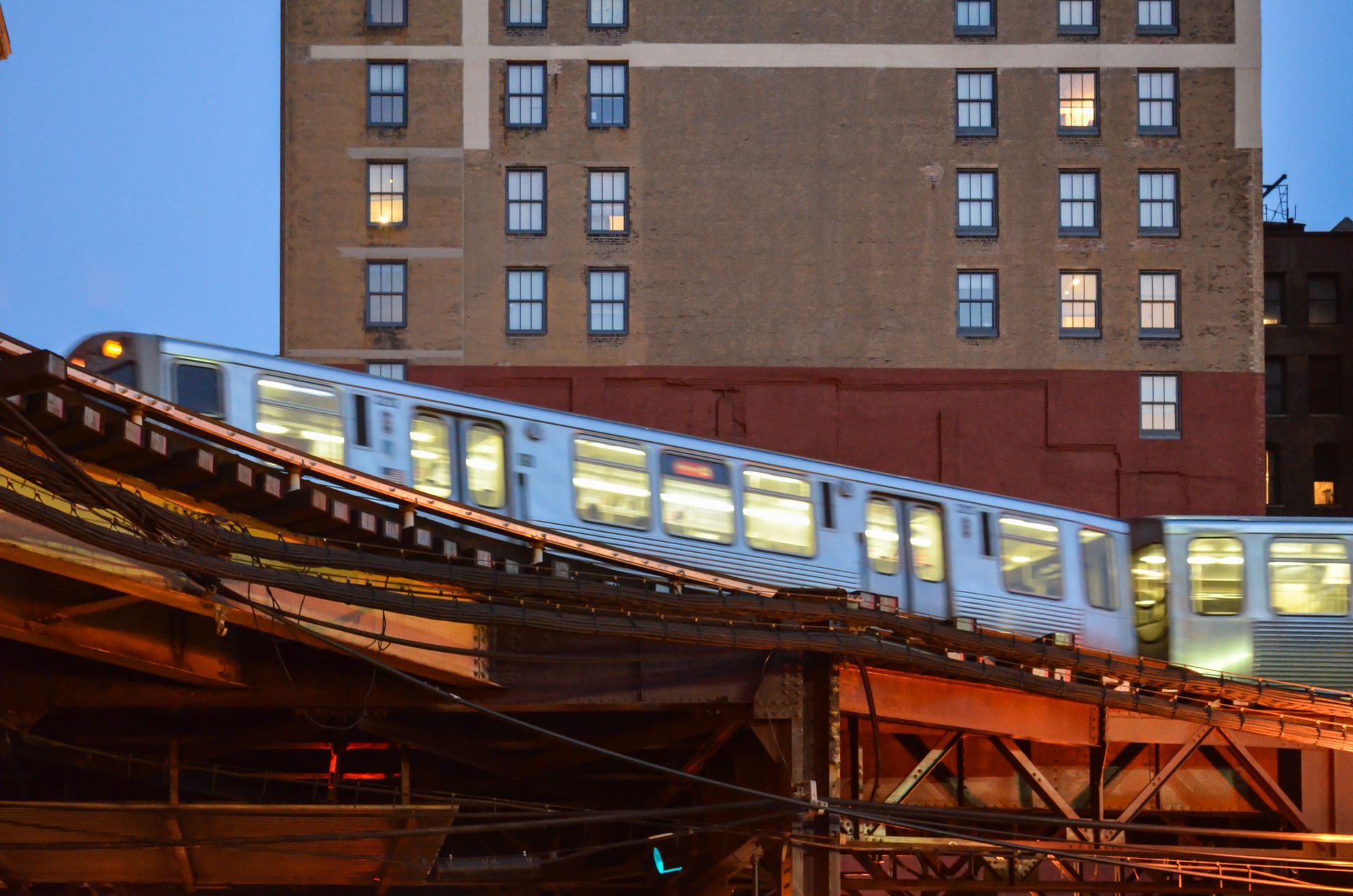
Served by the CTA Green Line at the Austin station and a separate Blue Line Austin station toward the Loop.
Columbus Park
A 135-acre National Historic Landmark and the masterpiece of Prairie School landscape architect Jens Jensen.
Schock landmark district
Four Queen Anne and Shingle-style homes by Frederick Schock were designated a Chicago Landmark district in 1999.
Laramie State Bank
The Art Deco Laramie State Bank Building of 1929 on Chicago Avenue is a Chicago Landmark now under redevelopment.
What it’s actually like to live here
Daily life in Austin clusters around its historic commercial corridors, including Chicago Avenue, home to the Soul City business and cultural district where the landmark Laramie State Bank is being redeveloped into a blues music museum, cafe, and business incubator, plus the Madison Street and Lake Street corridors that have anchored West Side commerce for more than a century. The community is well connected to downtown by transit: the CTA Green Line runs along the old Lake Street elevated with an Austin station between Ridgeland and Central, and a separate Austin station serves the Blue Line, giving residents two rapid-transit options toward the Loop. With a Walk Score of 71, most errands can be done on foot.
Green space and community institutions are central to neighborhood life. Columbus Park, the 135-acre Jens Jensen masterpiece on the far West Side, offers a meandering prairie-style lagoon, waterfalls, and a golf course, while Austin Town Hall Park and Cultural Center provides an indoor pool, gymnasium, fitness center, and a performance auditorium. Community organizations such as BUILD, Inc. and Austin Coming Together anchor local civic life and youth programming. The housing character remains rooted in owner-occupied greystones, two-flats, and bungalows that give Austin its dense, residential, classically Chicago streetscape.
Around town
What there is to do in Austin.
A handful of the places people who live here actually use. Not a directory.
- Parks
Columbus Park
A 135-acre National Historic Landmark and the masterpiece of Prairie School landscape architect Jens Jensen, with a prairie-style lagoon and waterfalls.
- Recreation
Austin Town Hall Park and Cultural Center
A Georgian Revival fieldhouse with an indoor pool, gym, fitness center, and performance auditorium, modeled in part on Independence Hall.
- Landmark
Laramie State Bank Building
An exuberant 1929 Art Deco Chicago Landmark on Chicago Avenue, now being redeveloped into a blues music museum and community campus.
- Culture
Four Houses by Architect Frederick Schock
A Chicago Landmark district of four Queen Anne and Shingle-style homes built 1886 to 1892 that shaped early Austin.
- Culture
Historic Austin Architecture Tour
A Chicago Architecture Center walking tour through Austin's greystone, bungalow, and Prairie School architectural heritage.
- Culture
BUILD, Inc. Austin Campus
A 51,000-square-foot youth and community center on West Harrison Street offering mentoring, STEAM education, and recreation.
By the numbers
Austin taxes + market stats.
Property tax rates vary by exact township and assessor district. Confirm per address before pricing a purchase.
Median sold price
$317,500
MRED · last 12 mo (174 sales)
How Austin got here
A bit of history.
Austin began in 1865, when developer Henry W. Austin purchased a large tract of land west of Chicago and laid out a subdivision of wide, shaded streets along the Chicago and North Western railroad line, seven miles due west of downtown, within Cicero Township. The arrival of the Lake Street Elevated Railroad, which reached Austin Avenue in April 1899, helped fuel the suburb's growth. That same elevated extension triggered a political fight: Austin controlled the Cicero Township government and pushed the line through over the objections of the rest of the township, which retaliated by putting Austin's annexation to Chicago up for a referendum. A majority of Austin's own voters rejected annexation, but the rest of Cicero Township carried the vote, and on October 25, 1899, Austin awoke as part of the City of Chicago.
Through the late 1800s and early 1900s, Austin filled in with the architecture that still defines it, including the four landmark Queen Anne and Shingle-style homes designed by local architect Frederick R. Schock between 1886 and 1892. Civic landmarks followed, including the Georgian Revival Austin Town Hall, modeled in part on Philadelphia's Independence Hall, and the Art Deco Laramie State Bank Building of 1929. In the late 1960s and 1970s the community underwent a rapid demographic transformation, and Austin today is a predominantly Black community. Long-serving institutions emerged from this era, including BUILD, Inc., founded in 1969 to support West Side youth.
The questions buyers actually ask
Austin FAQ
The questions I get most from buyers shopping Austin. If yours isn't here, text 224-385-8779, same-day reply.
- Where is Austin located in Chicago?
- Austin is on the far West Side, about seven miles west of the Loop, bordering suburban Oak Park at the city limits along Austin Boulevard.
- How big is Austin?
- It covers about 7.16 square miles with 98,882 residents as of the 2020 Census, making it Chicago's second-largest community area by both population and land area.
- What kind of homes will I find here?
- Austin's housing stock features classic Chicago greystones, brick two-flats, and bungalows, plus historic Queen Anne and neoclassical homes, some by architect Frederick R. Schock.
- Is Austin walkable and well connected to transit?
- Yes. It has a Walk Score of 71 with good public transportation, and it is served by both the CTA Green Line and Blue Line via separate Austin stations.
- What are the best-known landmarks in Austin?
- Columbus Park, a Jens Jensen-designed National Historic Landmark, the Art Deco Laramie State Bank Building, and the Schock-designed Chicago Landmark historic district.
- When did Austin become part of Chicago?
- Austin was annexed to the City of Chicago on October 25, 1899, after a contentious Cicero Township referendum, despite a majority of Austin's own voters opposing it.
- What is the housing market like?
- Specific Austin median figures vary by source, but the broader Chicago market posted a median sale price of $379,900 in May 2026, up year over year.
- Who is the real estate agent for Austin?
- Joe Keegan is the local licensed Illinois real estate broker who covers Austin in Austin, IL through Subdiview, a neighborhood-first home search for the Chicago suburbs and collar counties. Joe prices and negotiates from the live MRED sold comps for Austin specifically, not national averages, and can help you buy or sell here. Reach Joe at 224-385-8779 or joe@joekeeganhomes.com.
Nearby
Neighborhoods near Austin.
If you’re cross-shopping the area, these are the neighborhoods right next to Austin.
Your local agent
Joe knows Austin
Most agents will list anything. I focus on the places I actually know, and the things that move value here don't show up in the MLS write-up: which streets and buildings hold demand, what the HOA or assessments really cover, how the comps read once you account for condition and location, and where buyers consistently want to be.
When you're ready to tour or list, you want someone who has read the last 50 closed comps in this specific market, not a national average, and can tell you what they actually mean for your price. That's how I work. Text or call any time, and I'll give you a real take, not a brochure.
- Licensed Illinois broker
- Comp-driven pricing
- Austin specialist
- Honest local market take
- Brokerocity
Thinking of selling?
What's your home actually worth?
Not a Zestimate. A real CMA from someone who's sold this neighborhood, knows the floor plan premiums, and can tell you which upgrades the buyer pool here actually pays for.
- Pricing range with comp-by-comp logic
- Pre-list improvements that pay back, and the ones that don't
- No obligation, no spam, no auto-dialer