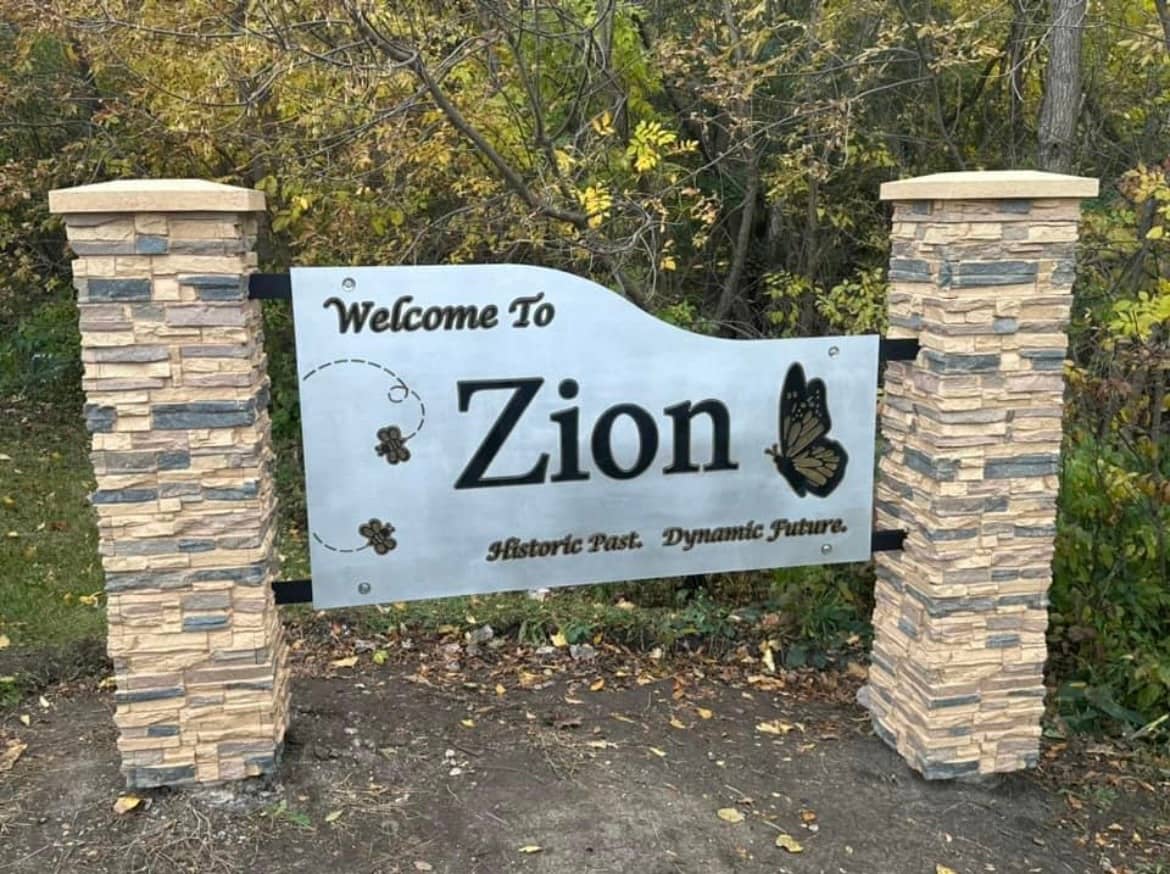
Zion · Lake County · IL
Homes for sale in
Zion.
- Active listings
- 32
- Median list
- $293K
- Avg time on market
- 22 days
- Sold · last year
- 243
Active listings
32 homes on the market


Be the first to know when a new Zion home hits the market
Text + email the moment a new listing matches.
About the community
Living in Zion.
Zion is the cheap end of Lake County's lakefront, and there is a real reason for the price. The city sits 42 miles north of downtown Chicago, hugs six miles of Lake Michigan shoreline through Illinois Beach State Park, and was literally master-planned in 1901 as a religious utopia with streets named in alphabetical order after biblical figures. Median home values run around $166,000 per Zillow, roughly half the Lake County median, but the effective property tax rate is the highest in the county at around 3.94 percent, so a $5,700 median bill on a sub-$200K house is normal. Schools (Zion Elementary District 6 and Zion-Benton Township District 126) score below state averages on the Illinois Report Card. The Metra UP-N station gets you to Ogilvie in about 90 minutes. If you want a starter house near the lake and you understand the tax math, Zion is a real option. If you want strong schools or a tight commute, this is not your town.
At a glance
6.5 miles of Lake Michigan shoreline
Illinois Beach State Park stretches the entire eastern edge of the city with beaches, dunes, and a marina.
Metra UP-N station
Zion station sits 42.1 miles from Ogilvie Transportation Center in downtown Chicago.
Founded 1901 as a religious utopia
John Alexander Dowie planned the city as headquarters of the Christian Catholic Apostolic Church.
Streets named for biblical figures
Antioch through Ezekiel and beyond, laid out alphabetically east to west.
Former Zion Nuclear Power Station
Two reactors operated 1973-1998 on the lakefront. Site released by NRC for unrestricted use in 2023.
Lowest-priced lakefront-adjacent housing in Lake County
Zillow typical home value around $166,000, well under the county median.
Highest effective property tax rate in Lake County
Effective rate around 3.94 percent per Ownwell. Median bill roughly $5,703.
Population 24,655 (2020 Census)
Majority-minority city, ~44 percent Hispanic, ~25 percent White, ~23 percent Black per Data USA.
What’s close
Zion occupies the northeast corner of Lake County, pinned between the Wisconsin state line, Lake Michigan, and the I-94 corridor.
- On Lake Michigan
- The eastern boundary is Lake Michigan. Illinois Beach State Park runs the full lakefront.
- South of the Wisconsin line
- Winthrop Harbor sits between Zion and the Wisconsin border. Kenosha is about 15 minutes north.
- North of Waukegan via Beach Park
- Beach Park separates Zion from Waukegan. Both are Sheridan Road / IL-137 corridor cities.
- About 6 miles east of I-94
- Interstate 94 (Tri-State Tollway) is the main north-south expressway. Zion connects via IL-173.
- 42 miles north of downtown Chicago
- Per Metra distance, Zion station is 42.1 miles from Ogilvie Transportation Center.
- Lake County, not Cook
- Zion is in Lake County, IL, which means Lake County property tax and school district rules apply.
What it’s actually like to live here
Day-to-day life in Zion is shaped by the lake and by the grid Dowie laid out a century ago. Illinois Beach State Park gives residents six and a half miles of public Lake Michigan shoreline, dune ecosystems, hiking and biking trails, a marina, and one of the few state park campgrounds in the Chicago region. The street grid still carries Dowie's biblical names, and Shiloh House, his 25-room mansion built in 1901-02, operates as the Zion Historical Society museum and is listed on the National Register of Historic Places. Shiloh Park downtown hosts the city's biggest annual event, the Fourth of July Festival with carnival rides and fireworks.
The demographic and economic reality is straightforward. Zion is a working-class, majority-minority community. About 16 percent of residents live below the poverty line, the median household income runs around $63,000, and the largest employment sectors are health care, manufacturing, and retail. Schools are the biggest single trade-off prospective buyers need to understand, and the property tax rate, the highest in Lake County, eats into the 'cheap house' math quickly. Crime statistics run higher than in most of Lake County, though the lakefront and the older Dowie-era neighborhoods near downtown have a settled, walkable feel that newer subdivisions in the county cannot replicate. For buyers who want lakefront access at a Lake County entry-level price and are comfortable with the school and tax trade-offs, Zion delivers something genuinely rare.
Neighborhoods
Detailed Zion community pages coming soon.
Browse the listings above. Detailed neighborhood pages with market stats, school info, and lifestyle take-downs land here as we roll them out.
Schools
Districts serving Zion.
Boundary lines do shift. Always confirm in writing for a specific address before writing an offer.
- D6Grades Pre-K – 8
Zion Elementary School District 6
Schools serving the area
- Lakeview Elementary
- Beulah Park Elementary
- Elmwood Elementary
- Zion Central Middle School
Serves roughly 2,000 students across seven schools organized by grade-level center (PreK-2, 3-5, 6-8) rather than traditional K-5 / 6-8 splits. District boundaries cover most of the city of Zion.
- D126Grades 9 – 12
Community High School District 126 (Zion-Benton Township)
Schools serving the area
- Zion-Benton Township High School
- New Tech High @ Zion-Benton East Campus
Serves about 2,573 students from Zion, Beach Park, and Winthrop Harbor at the main campus on Kenosha Road and 21st Street. One of the most diverse high schools in Illinois.
Homes by school
Homes for sale by school in Zion
Around town
What there is to do in Zion.
A handful of the places people who live here actually use. Not a directory.
- Parks
Illinois Beach State Park
Six and a half miles of Lake Michigan shoreline with dunes, hiking trails, a marina, swimming beach, and 650+ plant species across multiple ecosystems.
- Culture
Shiloh House
Dowie's 25-room 1901-02 mansion, on the National Register of Historic Places, now headquarters of the Zion Historical Society with the founder's writings, furniture, and pulpit on display.
- Culture
Zion-Benton Public Library
Full-service public library at 2400 Gabriel Ave with programs, study rooms, and Lake County interlibrary access.
- Parks
Shiloh Park
Zion's main downtown park, host of the Fourth of July Festival with carnival rides, children's activities, and fireworks on the original Dowie-era boulevard plan.
- Family
Shepherd's Crook Golf Course
Public 18-hole course built on the former Commonwealth Edison nuclear plant property, one of several Zion-area courses open to the public.
- Food & Drink
Illinois Beach Resort
Lakefront hotel and restaurant inside Illinois Beach State Park with views over Lake Michigan, comfort food, and a full bar. One of the only true lakefront dining rooms in Lake County.
Getting around
Commute + transit from Zion.
- Stations: Zion
- Terminal: Chicago Ogilvie (OTC)
- Distance: 42.1 miles to downtown Chicago
- Routes: IL 173 · IL 137 (Sheridan Road) · IL 131 (Green Bay Road) · I-94 (~6 mi west)
- Downtown Chicago: ~60 min
- O'Hare Airport: ~49 min
- Milwaukee: ~54 min
- Waukegan: ~12 min
By the numbers
Zion taxes + market stats.
Property tax rates vary by exact township and assessor district. Confirm per address before pricing a purchase.
Property tax rate
3.94%
effective avg
Sales tax
8.50%
combined
Median sold price
$269,900
MRED · last 12 mo (243 sales)
Median household income
$63,104
ACS
How Zion got here
A bit of history.
Zion was founded in 1901 by John Alexander Dowie, a Scots-Australian evangelist and faith healer who bought roughly 6,600 acres 40 miles north of Chicago to build the headquarters of his Christian Catholic Apostolic Church. Dowie personally owned all of the land and most of the businesses, and the city was governed as a theocracy with the church controlling commerce, alcohol prohibition, and even what newspapers residents could read. He laid out the street grid alphabetically with names drawn from the Bible (Antioch, Aquila, Berea, Damascus, Deborah, Ebenezer, Eli, Elijah, Ezekiel, Gabriel, Galilee, Hebron, and so on). Financial collapse forced Dowie out by 1906, and the city passed to Wilbur Glenn Voliva, a flat-earth proponent who ran Zion until 1935, when the theocratic governance finally ended.
The second defining chapter was the Zion Nuclear Power Station, two Westinghouse pressurized water reactors on 257 acres of Lake Michigan shoreline that came online in 1973 and 1974 and supplied a large share of northern Illinois's electricity. Commonwealth Edison shut the plant down in February 1998 rather than pay for a mandatory steam-generator replacement, and accelerated decommissioning under EnergySolutions / ZionSolutions began in 2010 in what became the largest commercial nuclear dismantling ever undertaken in the U.S. The NRC released most of the site for unrestricted use in 2023, though a spent-fuel storage facility remains on the lakefront. Modern Zion is a working-class, majority-minority city of about 24,655 people per the 2020 Census, anchored by Illinois Beach State Park, the Metra UP-N station, and the historic Shiloh House museum.
The questions buyers actually ask
Zion FAQ
The questions I get most from buyers shopping Zion. If yours isn't here, text 224-385-8779, same-day reply.
- Are Zion's schools any good?
- Honest answer, not by Lake County standards. Both Zion Elementary D6 and Zion-Benton D126 score below state averages on the Illinois Report Card, and the student body is heavily lower-income and majority-minority. If schools are your top criterion, look at Libertyville, Vernon Hills, or Stevenson HSD 125 instead. If you are buying for the house and the lake and your kids are out of school or going private, the district is less of a factor.
- What is the commute to Chicago really like?
- The Metra UP-N station in Zion is 42.1 miles from Ogilvie Transportation Center. Schedule is roughly 90 minutes one-way at rush hour. Driving down I-94 is about 60 minutes off-peak and easily 90-plus in traffic. Zion works for a one- or two-day-a-week hybrid schedule. It does not work as a five-day downtown commute unless you genuinely enjoy your train time.
- Why are property taxes so high if home values are so low?
- Lake County levies are based on assessed value relative to local services, and Zion has a small commercial tax base, a closed nuclear plant that used to carry a huge share of the levy, and large school and municipal needs serving a lower-income population. The result is the highest effective property tax rate in Lake County, around 3.94 percent. A $180,000 house here can carry the same annual tax bill as a $300,000 house in Vernon Hills.
- What's the deal with the biblical street names and the planned-city history?
- Zion was founded in 1901 by John Alexander Dowie as the headquarters of his Christian Catholic Apostolic Church. He owned the land, ran the businesses, and laid out the streets alphabetically with names from the Bible (Antioch, Aquila, Berea, Damascus, and so on across the entire grid). The theocratic governance lasted until 1935. The street names are still there. Shiloh House, Dowie's original mansion, is the museum.
- Is the former nuclear plant a problem for buyers?
- The Zion Nuclear Power Station shut down in 1998 and was fully decommissioned through 2023. The NRC released most of the 257-acre site for unrestricted use, though a small spent-fuel storage facility remains on the lakefront under continuing NRC oversight. It is not a residential exposure concern at this point. The bigger lingering effect is the loss of the property tax revenue the plant used to generate, which is part of why the residential tax rate is so high.
- What neighborhoods should I look at in Zion?
- The grid south and east of downtown, near Shiloh Park and the Metra station, has the most architectural character and the closest lake access. Subdivisions west of Green Bay Road tend to be newer ranches and split-levels on larger lots. Anything within walking distance of Illinois Beach State Park carries a premium relative to the rest of the city, which is still cheap by Lake County standards.
- Is Zion worth it?
- It depends entirely on what you are solving for. If you want the cheapest possible single-family house with real Lake Michigan access in Lake County and you are okay with the tax rate and the school reality, Zion is one of the best values left in the north suburbs. If you want strong schools, a short commute, or appreciation in line with the rest of Lake County, look further south.
- Who is the real estate agent for Zion?
- Joe Keegan is the local licensed Illinois real estate broker who covers Zion in Zion, IL through Subdiview, a neighborhood-first home search for the Chicago suburbs and collar counties. Joe prices and negotiates from the live MRED sold comps for Zion specifically, not national averages, and can help you buy or sell here. Reach Joe at 224-385-8779 or joe@joekeeganhomes.com.
Nearby
Towns next to Zion.
If you’re cross-shopping the area, these are the places that border Zion.
Your local agent
Joe knows Zion
Most agents will list anything. I focus on the places I actually know, and the things that move value here don't show up in the MLS write-up: which streets and buildings hold demand, what the HOA or assessments really cover, how the comps read once you account for condition and location, and where buyers consistently want to be.
When you're ready to tour or list, you want someone who has read the last 50 closed comps in this specific market, not a national average, and can tell you what they actually mean for your price. That's how I work. Text or call any time, and I'll give you a real take, not a brochure.
- Licensed Illinois broker
- Comp-driven pricing
- Zion specialist
- Honest local market take
- Brokerocity
Thinking of selling?
What's your home actually worth?
Not a Zestimate. A real CMA from someone who's sold this neighborhood, knows the floor plan premiums, and can tell you which upgrades the buyer pool here actually pays for.
- Pricing range with comp-by-comp logic
- Pre-list improvements that pay back, and the ones that don't
- No obligation, no spam, no auto-dialer