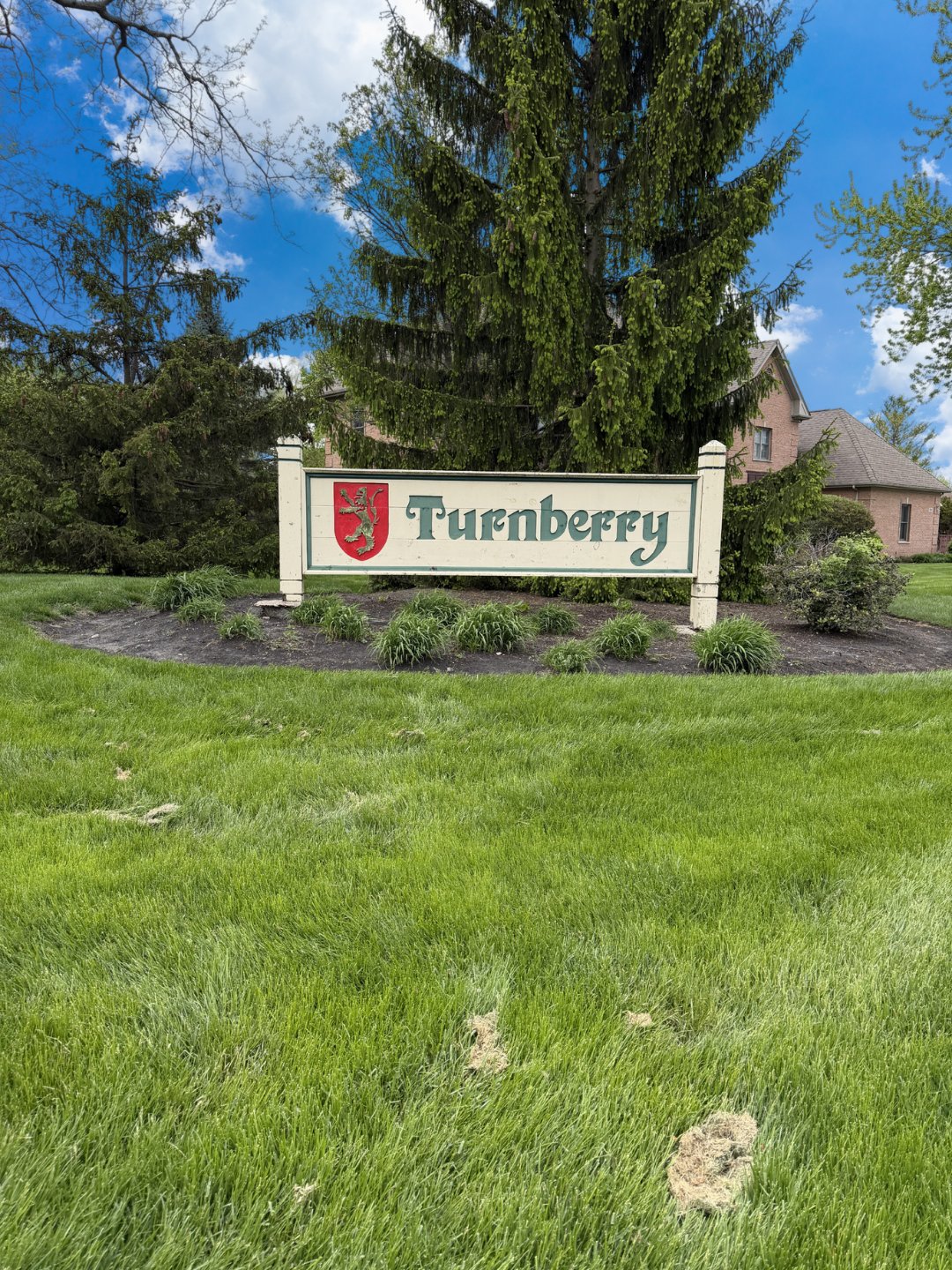
Lakewood · McHenry County · IL
Homes for sale in
Turnberry.
- Active listings
- 2
- Median list
- $740K
- Avg time on market
- 165 days
- Sold · last year
- 21
Active listings
2 homes on the market


Beat the rest of the buyers
Be the first to know when a new Turnberry home hits the market
Save the search and you will get a text and an email the moment a new listing matches. Most Turnberry homes go under contract in the first week, the buyers who win are the ones who saw it first.
About the community
The premier Lakewood subdivision.
Turnberry was platted in the early 1970s by Arthur T. McIntosh & Company, the developers behind Inverness, Prestwick, and Farmington, on 750+ acres of former Bard family farmland. The vision was unusual then and still is now: winding country lanes, no curbs, no sidewalks, no streetlights, fine homes on acre-scale lots, and a golf course at the heart of it all. The country club opened in 1972, real estate sales began the same year, and the architectural standards designed to keep the place from looking like every other suburban tract are still enforced today through the Village of Lakewood code. Four community lakes, mature trees, and roughly 450 homes spread across a layout that doesn't feel like a 1990s grid.
At a glance
Golf course at the heart
Turnberry Golf Club (open since 1972) sits inside the neighborhood. Larry Packard designed the original 18 holes.
No curbs, no sidewalks, no streetlights
Intentional rural country-lane feel. McIntosh refused to develop in Crystal Lake because Crystal Lake required them.
Anti-monotony code, custom homes
Architectural standards written into Village code, no two houses look alike, no fences or walls allowed, mature landscaping is the rule.
Four community lakes
Lakes One through Four anchor the layout. Lake One is the largest; backstop pipeline from the Kishwaukee River keeps levels stable.
No traditional HOA
No private HOA dues. Architectural standards are enforced by Village of Lakewood code; a Special Service Area tax funds lake/entrance maintenance.
Acre-scale lots
Original vision was acre lots; today's lots range from large suburban to true acre depending on which street. Wooded backings are common.
Lakewood schools
Generally Crystal Lake D47 elementary + D155 high school. Verify per address, boundary lines can shift.
Crystal Lake Metra accessible
UP-NW line into Chicago Ogilvie for occasional commuters.
What’s close
Turnberry sits inside the Village of Lakewood, just southwest of Crystal Lake along Lakewood Road and Bard Road. McIntosh deliberately chose tiny Lakewood over Crystal Lake to preserve the no-curb-no-sidewalk aesthetic, the result is a neighborhood that's geographically next door to Crystal Lake but feels like a different era.
- Turnberry Golf Club
- 9600 Turnberry Trail, inside the neighborhood. Open to non-residents, see the membership FAQ below.
- Downtown Crystal Lake
- ~10 minutes. Raue Center, restaurants, weekly farmers' market.
- Crystal Lake Metra
- UP-NW line into Chicago Ogilvie. ~10-minute drive to the station.
- Schools
- South Elementary or West (D47), Bernotas or Hannah Beardsley Junior High, Crystal Lake Central or South High School (D155). Confirm per address.
- Hospital
- Northwestern Medicine McHenry, ~20 minutes.
- Highway
- Routes 14, 31, 176 close; I-90 via Randall Road.
- Shopping / Randall Road corridor
- Big-box and dining cluster ~10-15 minutes east.
What it’s actually like to live here
Turnberry doesn't look like other Lakewood-area subdivisions because it wasn't supposed to. Arthur T. McIntosh's idea was a country-style enclave with winding lanes, mature trees, and homes that felt like they belonged on a single landscape rather than a developer's grid. The no-curb / no-sidewalk / no-streetlight rule still defines the visual experience, drive in at dusk and the neighborhood feels more like a private estate than a subdivision.
The Turnberry Golf Club is the gravity. Originally an equity members-only club, today's club operates as a more accessible Turnberry Golf Club, no initiation fees, social memberships available, golf memberships at multiple tiers. Some Turnberry residents play four times a week. Others have never set foot in the clubhouse. Both versions of Turnberry life work; the club is an option, not an obligation.
Architectural review still has teeth, but it's enforced by the Village, not a private HOA. Jerry Cook had Turnberry's original deed covenants written into the Lakewood village code in the late 1980s, so anti-monotony rules, the no-fence rule, and the architectural standards are all real and still applied today. The Special Service Area tax (charged annually by the Village, not an HOA) covers lake maintenance, entrance landscaping, and the things that keep the neighborhood feeling like itself.
Market trends
Why this market moves the way it does
Turnberry is supply-constrained and address-driven. The buyer pool skews to people who specifically want acre-scale lots, mature trees, and the rural-country-lane look McIntosh designed in. Inventory is thin, the home stock is varied (1972 originals, 1986-2008 buildout, custom infill since), and the architectural review keeps tear-down-and-build-a-McMansion strategies off the table.
What holds value
The fundamentals matter more than the cosmetics here. Buyers want floor plan, lot, and basement, in that order. Cosmetics are the tiebreaker.
- Lake or golf-course frontage
- Direct lake or fairway frontage commands the strongest premium, those lots are finite and the original McIntosh plan made them the centerpiece.
- Lot quality + tree cover
- Wooded acre or near-acre lots are the Turnberry differentiator. Open-front lots without mature trees underperform.
- Architectural fit
- Original McIntosh-era homes that have been thoughtfully updated outperform 1990s teardowns built to maximum lot coverage. The neighborhood rewards homes that look like they belong in the neighborhood.
- Updated systems on older homes
- 1972-1989 vintage homes need updated mechanicals, roofs, and primary suites. Buyers at this tier expect those done.
- Turnberry Golf Club proximity
- Walking distance to the clubhouse is a measurable resale boost, even for buyers who won't join, the option matters.
- Typical close
- 30–45 days. Older homes with septic issues (a few still on private septic before village sewer extension) can stretch the timeline.
Real talk
Who shouldn’t buy here
What buyers actually need to know.
There's no traditional HOA, but there IS a Special Service Area tax. The Village charges an annual SSA assessment that funds lake maintenance, entrance upkeep, and common-area work. It's not optional and it's not bundled with country club membership, it's part of your Lakewood property tax bill. Ask for the current dollar amount on the specific address before you write an offer.
The architectural review is real. If you're buying with plans to tear down and build a 6,000-sqft modern boxy thing, expect resistance from the Village's code-enforcement of the McIntosh anti-monotony rules. Talk to the Village Building Department before you write the offer if a major rebuild is part of the plan.
The country club today is much more accessible than the 1988 equity-club version. Social memberships start at $250/year and there are no initiation fees on golf memberships. That's a meaningful change from the historical framing, don't let outdated assumptions about cost steer you away from a club tour.
Some streets are quieter than others by design. The original Fairway / Partridge / Braemar / Inverway pocket has the deepest mature landscape. The Muirfield section was added later by McIntosh Ltd. and tends to be slightly newer construction. Walk a few streets before you commit, they really do feel different.
One piece of advice
“Tour the Turnberry Golf Club before you tour homes. Spend an hour at the bar, walk the grounds, ask about social membership. Whether you'd actually use the club shapes which streets in Turnberry make sense for you, and changes the math on what you can spend on the house.”
The questions buyers actually ask
Turnberry FAQ
The questions I get most from buyers shopping Turnberry. If yours isn't here, text 224-385-8779, same-day reply.
- When was Turnberry built?
- Multiple builders / mostly custom (Pulte built early 1986-era homes; small builders since) built the community between 1972 and 2025. There are 450+ homes total. Multiple builders / mostly custom (Pulte built early 1986-era homes; small builders since) stopped new construction in 2025, so every sale today is a resale.
- What's the typical closing timeline?
- 30 to 45 days from accepted offer to keys. Cash deals can close in two weeks. Conventional financing is usually closer to 45.
- Is there an HOA at Turnberry?
- No traditional HOA. Architectural standards are enforced by the Village of Lakewood code (the original McIntosh deed covenants were written into village ordinance in the late 1980s). The Village charges a Special Service Area (SSA) tax that funds lake maintenance, entrance landscaping, and common-area upkeep, that's part of your Lakewood property tax bill, not a separate HOA fee. Confirm the current SSA assessment on the specific address before writing an offer.
- Is Turnberry Golf Club membership required to live in Turnberry?
- No. Membership is completely separate from homeownership and there are no initiation fees today. Tiers as of 2026: Social membership $250/year (tennis, pickleball, basketball, club events), Senior Silver golf $279, Silver $319, Platinum (full-week golf) $3,000, Couples Platinum $4,500. Some Turnberry residents are at the clubhouse weekly; others never join. Both work.
- Why doesn't Turnberry have curbs, sidewalks, or streetlights?
- Intentional design choice by Arthur T. McIntosh, who developed Turnberry in the early 1970s on the model of his earlier Inverness community. McIntosh actually refused to develop Turnberry inside Crystal Lake because Crystal Lake required curbs and sidewalks, those would have spoiled the rural country-lane feel. He incorporated a strip into the tiny Village of Lakewood instead. The aesthetic is preserved by Village code today.
- What schools serve Turnberry?
- Lakewood addresses generally feed Crystal Lake Elementary School District 47 (typically South or West Elementary, Bernotas or Hannah Beardsley Junior High) and Community High School District 155 (Crystal Lake Central or South). Boundary lines can shift, confirm in writing for the specific home before writing an offer.
- How old are Turnberry homes?
- Buildout started in 1972 and continues to this day, so the home stock is genuinely varied. Original 1970s McIntosh-era homes, a slow buildout in the 1980s, a major surge from 1986 through 2008 (Pulte built some, plus various small custom builders), and steady custom infill since. Expect 1970s-2020s vintage depending on the street.
- Are there sub-sections within Turnberry?
- The original McIntosh-era pocket was Fairway Drive, Partridge Lane, Braemar Circle, and Inverway. Muirfield Drive was added later by McIntosh Ltd. and is generally considered part of original Turnberry. There's no formal subdivision split, MRED listings should all show 'Turnberry' as the subdivision name.
- What's around Turnberry?
- Turnberry is in the Village of Lakewood, southwest of Crystal Lake. Downtown Crystal Lake (Raue Center, restaurants, farmers' market) is roughly 10 minutes by car. Crystal Lake Metra (UP-NW line into Chicago Ogilvie) is about the same. Randall Road big-box and dining is 10-15 minutes east. Northwestern Medicine McHenry is about 20 minutes north.
- Is Turnberry gated?
- No. There's no staffed gate. The neighborhood is private-feeling because of the design, winding lanes, no streetlights, mature landscape, but it's openly accessible by car. The golf course and clubhouse are members-only / private; the streets and common areas are not gated.
- Who is the real estate agent for Turnberry?
- Joe Keegan is the local licensed Illinois real estate broker who covers Turnberry in Lakewood, IL through Subdiview, a neighborhood-first home search for the Chicago suburbs and collar counties. Joe prices and negotiates from the live MRED sold comps for Turnberry specifically, not national averages, and can help you buy or sell here. Reach Joe at 224-385-8779 or joe@joekeeganhomes.com.
Your local agent
Joe knows Turnberry
Most agents will list anything. I focus on the places I actually know, and the things that move value here don't show up in the MLS write-up: which streets and buildings hold demand, what the HOA or assessments really cover, how the comps read once you account for condition and location, and where buyers consistently want to be.
When you're ready to tour or list, you want someone who has read the last 50 closed comps in this specific market, not a national average, and can tell you what they actually mean for your price. That's how I work. Text or call any time, and I'll give you a real take, not a brochure.
- Licensed Illinois broker
- Comp-driven pricing
- Lakewood specialist
- Honest local market take
- Brokerocity
Market snapshot
Turnberry, by the numbers
Live MRED data, refreshed daily. The numbers below tell you what this market is doing today, not what Zillow's algorithm thinks it might be doing six weeks from now.
Typical list price
$739,950
Typical sale price · last 90 days
$520,000
Homes for sale right now
2
Avg time on market
165 days
Sold in the last year
21
This representation is based in whole or in part on data supplied by Midwest Real Estate Data, LLC for the period September 22, 2025 through September 22, 2026. Midwest Real Estate Data, LLC does not guarantee nor is it in any way responsible for its accuracy. Data maintained by Midwest Real Estate Data LLC may not reflect all real estate activity in the market.
Thinking of selling?
What's your home actually worth?
Not a Zestimate. A real CMA from someone who's sold this neighborhood, knows the floor plan premiums, and can tell you which upgrades the buyer pool here actually pays for.
- Pricing range with comp-by-comp logic
- Pre-list improvements that pay back, and the ones that don't
- No obligation, no spam, no auto-dialer
Other communities