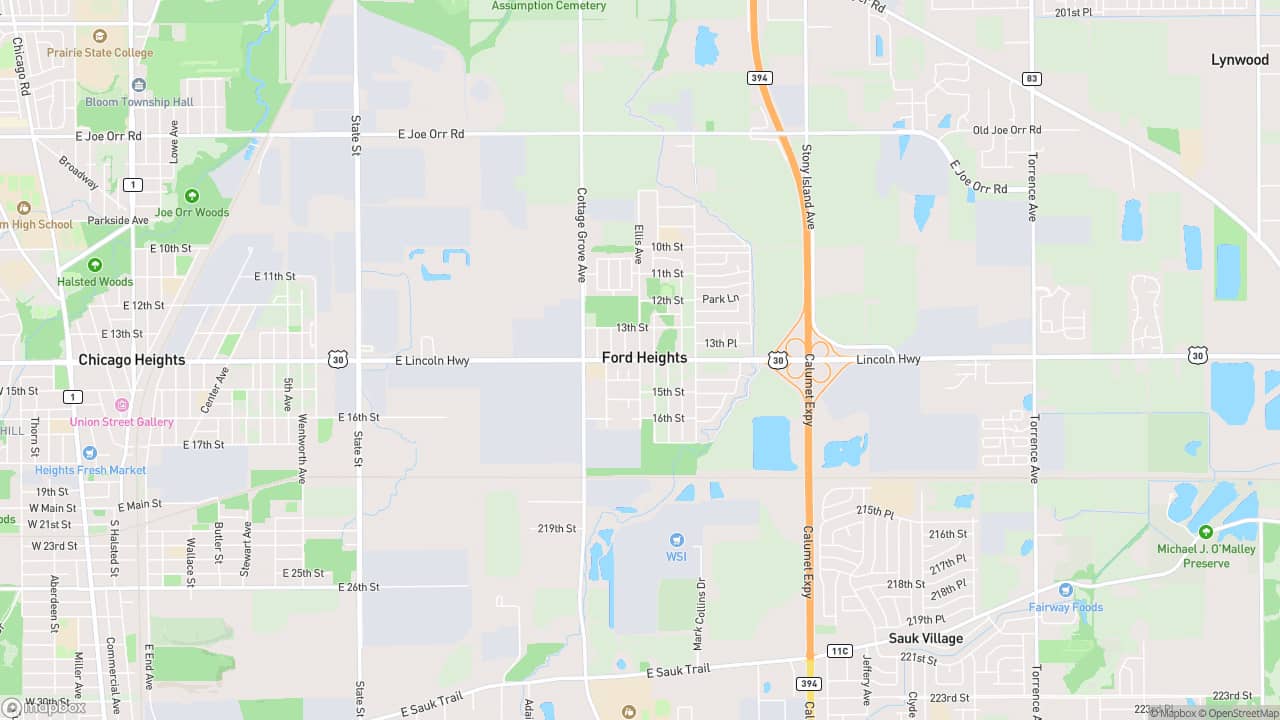
Ford Heights · Cook County · IL
Homes for sale in
Ford Heights.
- Active listings
- 8
- Median list
- $115K
- Avg time on market
- 47 days
- Sold · last year
- 6
Active listings
8 homes on the market


Be the first to know when a new Ford Heights home hits the market
Text + email the moment a new listing matches.
About the community
Living in Ford Heights.
Ford Heights is a village of about 1,800 residents in Bloom Township, in the far south suburbs of Cook County, roughly 30 miles south of downtown Chicago. Originally known as East Chicago Heights, it was incorporated in 1949 and renamed Ford Heights in 1987 after the nearby Ford Motor Company stamping plant. The community sits along the historic Lincoln Highway, U.S. Route 30, and has been a predominantly African American community since its incorporation. Ford Heights is one of the most affordable places to buy in the Chicago Southland, with a census-reported median home value around $80,200. Students are served by Ford Heights School District 169 and Bloom Township High School District 206.
At a glance
~1,800 residents
The 2020 census counted 1,813 people in a village of about 1.95 square miles.
Incorporated 1949
Founded as East Chicago Heights in 1949 and renamed Ford Heights in 1987.
Very affordable homes
The census-reported median home value is about $80,200, among the lowest in the Chicago region.
On the Lincoln Highway
U.S. Route 30, the historic Lincoln Highway, runs through the village as its main east-west road.
Pace bus service
Pace routes connect the village to Chicago Heights and other Southland destinations; there is no Metra station.
Districts 169 and 206
Ford Heights School District 169 serves PK-8 and high schoolers attend Bloom Trail High School in District 206.
Far south Cook County
Located in Bloom Township about 30 miles south of the Chicago Loop, near the Indiana state line.
~$36,000 median income
Median household income is about $36,053 according to the 2024 ACS.
What’s close
Ford Heights sits in the far southern corner of Cook County, about 30 miles south of downtown Chicago and close to the Indiana state line, along the historic Lincoln Highway corridor.
- Distance to the Loop
- About 30 miles south of downtown Chicago in Bloom Township.
- Lincoln Highway
- U.S. Route 30 runs east-west through the village as its primary road.
- Chicago Heights
- Borders Chicago Heights, which holds most of the area's larger retail and services.
- Forest preserves
- Cook County forest preserves and the Thorn Creek trail system are a short drive away.
- Transit
- Pace bus routes serve the village; the nearest passenger rail is in neighboring communities.
- Schools
- Ford Heights School District 169 runs the local elementary and middle grades, feeding into Bloom Township District 206.
What it’s actually like to live here
Ford Heights is a small, close-knit residential village in the Chicago Southland. With a census-reported median home value around $80,200, it offers some of the most affordable housing anywhere in the metro area, and the housing stock is predominantly single-family homes built during the village's mid-century growth. Larger retail and everyday shopping are concentrated in neighboring Chicago Heights.
Outdoor recreation in the area is anchored by the Forest Preserves of Cook County, whose Thorn Creek trail system threads nearly 23 miles through the south suburbs near the village. Nearby preserves such as Sauk Trail Woods and the Sand Ridge Nature Center give residents access to lakes, woodlands, and nature programs within a short drive.
Neighborhoods
Detailed Ford Heights community pages coming soon.
Browse the listings above. Detailed neighborhood pages with market stats, school info, and lifestyle take-downs land here as we roll them out.
Schools
Districts serving Ford Heights.
Boundary lines do shift. Always confirm in writing for a specific address before writing an offer.
- D169Grades Pre-K-8
Ford Heights School District 169
Schools serving the area
- Medgar Evers Primary Academic Center
- Cottage Grove Upper Grade Center
District 169 runs Medgar Evers Primary (PK-4) and Cottage Grove Upper Grade Center (5-8) for students within the village.
- D206Grades 9-12
Bloom Township High School District 206
Schools serving the area
- Bloom Trail High School
High school students living in Ford Heights attend Bloom Trail High School in Bloom Township District 206.
Around town
What there is to do in Ford Heights.
A handful of the places people who live here actually use. Not a directory.
- Parks
Sauk Trail Woods
A Cook County forest preserve with paved trails, Sauk Lake, and Thorn Creek, a short drive from Ford Heights.
- Family
Sand Ridge Nature Center
A nature center in nearby South Holland with interactive exhibits and about four miles of trails through woods and prairie.
- Parks
Thorn Creek Trail System
Nearly 23 miles of paved and unpaved trails connecting south-suburban communities through lakes, wetlands, and woods.
- Culture
Thorn Creek Woods Nature Preserve
A wooded preserve in nearby Park Forest with a nature center housed in a historic 1862 church.
- Parks
Lansing Woods
A Cook County forest preserve area along the Thorn Creek trail network in the south suburbs.
- Culture
Lincoln Highway
The historic transcontinental Lincoln Highway, U.S. Route 30, runs through the village as its main east-west route.
Getting around
Commute + transit from Ford Heights.
- Routes: Lincoln Highway / U.S. 30 · Sauk Trail · Cottage Grove Avenue
- O'Hare Airport: ~55 min
- Chicago Loop: ~45 min
By the numbers
Ford Heights taxes + market stats.
Property tax rates vary by exact township and assessor district. Confirm per address before pricing a purchase.
Property tax rate
8.39%
effective avg
Sales tax
10.00%
combined
Median sold price
$42,000
MRED · last 12 mo (6 sales)
Median household income
$36,053
ACS
How Ford Heights got here
A bit of history.
The area that became Ford Heights was first settled in the late 1840s and served as a stop on the Underground Railroad. By the early 20th century it was an agricultural community, and after World War I, African American families migrated from the South to work the farms. A subdivision called the Park Addition drew new residents in the early 1920s, gained electrical service in 1924, and by the 1930s the settlement was known as East Chicago Heights. The village was formally incorporated in 1949, with Charlie Williams as its first mayor.
In 1956 the Ford Motor Company opened a stamping plant next to the village, bringing well-paying jobs at a time when housing options for Black families in suburban Chicago were sharply limited. The population more than doubled to 3,270 by 1960 and peaked at 5,347 in 1980. In 1987 the village changed its name from East Chicago Heights to Ford Heights while trying, unsuccessfully, to annex the plant site, which was eventually absorbed by neighboring Chicago Heights. The village's population has declined substantially since its 1980 peak.
The questions buyers actually ask
Ford Heights FAQ
The questions I get most from buyers shopping Ford Heights. If yours isn't here, text 224-385-8779, same-day reply.
- What school district serves Ford Heights?
- Elementary and middle school students attend Ford Heights School District 169, which runs Medgar Evers Primary Academic Center for PK-4 and Cottage Grove Upper Grade Center for grades 5-8. High schoolers attend Bloom Trail High School in Bloom Township High School District 206.
- How much do homes cost in Ford Heights?
- Ford Heights is one of the most affordable communities in the Chicago Southland, with a census-reported median home value around $80,200. The housing stock is mostly single-family homes built during the village's mid-century growth.
- What are property and sales taxes like in Ford Heights?
- Ownwell reports a median effective property tax rate around 8.39 percent, which is very high relative to home values, and the combined sales tax rate is about 10 percent. Because rates and bills vary, confirm the actual tax bill for any specific property.
- How far is Ford Heights from downtown Chicago?
- Ford Heights sits about 30 miles south of downtown Chicago and roughly 47 miles from O'Hare International Airport, near the Indiana state line.
- Why is it called Ford Heights?
- The village was originally named East Chicago Heights. In 1987 it renamed itself Ford Heights after the nearby Ford Motor Company stamping plant, while unsuccessfully trying to annex the plant site.
- How do residents get around without a Metra station?
- Ford Heights has no Metra station. Pace bus routes connect the village to Chicago Heights and other south-suburban destinations, and the Lincoln Highway and Interstate access put regional job centers within driving range.
- Who is the real estate agent for Ford Heights?
- Joe Keegan is the local licensed Illinois real estate broker who covers Ford Heights in Ford Heights, IL through Subdiview, a neighborhood-first home search for the Chicago suburbs and collar counties. Joe prices and negotiates from the live MRED sold comps for Ford Heights specifically, not national averages, and can help you buy or sell here. Reach Joe at 224-385-8779 or joe@joekeeganhomes.com.
Nearby
Towns next to Ford Heights.
If you’re cross-shopping the area, these are the places that border Ford Heights.
Your local agent
Joe knows Ford Heights
Most agents will list anything. I focus on the places I actually know, and the things that move value here don't show up in the MLS write-up: which streets and buildings hold demand, what the HOA or assessments really cover, how the comps read once you account for condition and location, and where buyers consistently want to be.
When you're ready to tour or list, you want someone who has read the last 50 closed comps in this specific market, not a national average, and can tell you what they actually mean for your price. That's how I work. Text or call any time, and I'll give you a real take, not a brochure.
- Licensed Illinois broker
- Comp-driven pricing
- Ford Heights specialist
- Honest local market take
- Brokerocity
Thinking of selling?
What's your home actually worth?
Not a Zestimate. A real CMA from someone who's sold this neighborhood, knows the floor plan premiums, and can tell you which upgrades the buyer pool here actually pays for.
- Pricing range with comp-by-comp logic
- Pre-list improvements that pay back, and the ones that don't
- No obligation, no spam, no auto-dialer