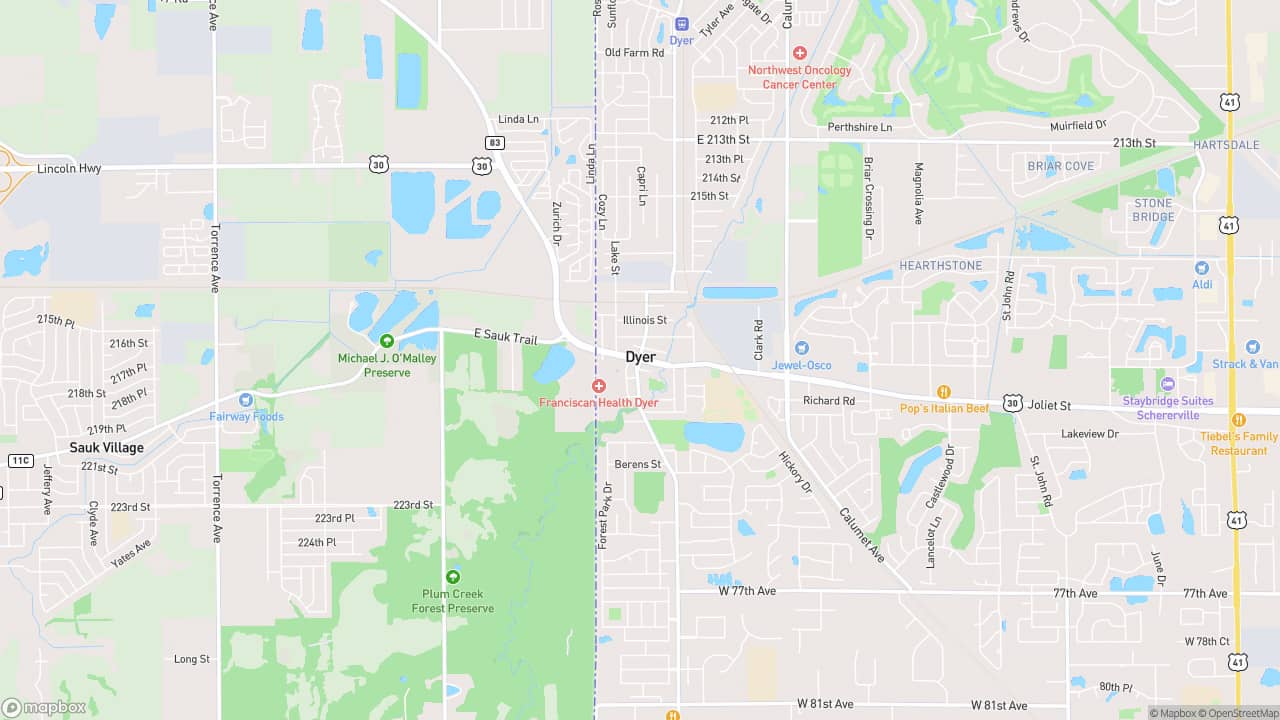
Dyer · Lake County · IN
Homes for sale in
Dyer.
- Active listings
- 5
- Median list
- $690K
- Avg time on market
- 97 days
- Sold · last year
- 7
Active listings
5 homes on the market


Be the first to know when a new Dyer home hits the market
Text + email the moment a new listing matches.
About the community
Living in Dyer.
Dyer is a town of roughly 16,500 people in St. John Township, Lake County, Indiana, on the Illinois state line. It is the western gateway of Northwest Indiana, sitting right where US 30 (the Lincoln Highway) crosses out of Illinois. The town was platted in 1855 around a Michigan Central rail station and incorporated in 1910. Most of the housing is detached single family, the median household income is over $100,000, and the median age skews a bit older. Lake Central School Corporation runs the public schools, and the new Munster/Dyer Main Street station on the South Shore West Lake Corridor is targeted to open in 2026, putting a one-seat ride to Millennium Station within reach for the first time.
At a glance
~16,517 residents
2020 Census population for the town. Stable, settled, predominantly owner-occupied single-family housing.
Lake Central School Corporation
LCSC serves Dyer, St. John, and Schererville. Most Dyer kids attend Bibich or Protsman Elementary, Kahler Middle School in Dyer, then Lake Central High School in St. John.
US 30 (Lincoln Highway) corridor
Main east-west commercial spine through town. The 1923 Ideal Section monument still marks where the Lincoln Highway Association built its showcase stretch of modern highway.
Munster/Dyer South Shore station (2026)
New West Lake Corridor branch terminus at the Munster/Dyer town line near Main Street. NICTD targets a 2026 opening for first one-seat commuter rail to Millennium Station.
Effective property tax ~1.14%
Indiana caps homestead bills at 1% of assessed value (constitutional circuit breaker) plus voter-approved debt. Ownwell reports a median effective rate around 1.14% on Dyer homes, well below comparable Cook County suburbs.
Indiana sales tax 7.0%
Flat 7% Indiana state sales tax with no county or city add-on in Dyer.
Meyer's Castle
1370 Joliet Street. 43-room Jacobethan replica of a Scottish castle built 1927 to 1931 for herbalist Joseph E. Meyer, now a wedding and event venue on 16 acres.
22 town parks
Including the 77-acre Central Park (largest, with 3-acre dog park), 23.7-acre Northgate Community Park for soccer, and Pheasant Hills with a skate park and 18-acre pond.
What’s close
Dyer is the first Indiana town on US 30 west of the state line, bordered by Lansing, IL on the west and Schererville on the east. The town runs roughly north-south between Munster on the north and unincorporated St. John Township on the south.
- Illinois state line / Lansing border
- Dyer's western edge is the Indiana state line. Cross it and you are in Lansing, IL.
- US 30 (Lincoln Highway) corridor
- The east-west commercial spine through Dyer. Auto dealers, restaurants, retail, and the Ideal Section monument.
- Meyer's Castle
- 1370 Joliet Street. 1927 to 1931 Jacobethan castle on 16 acres, now an event venue.
- Munster/Dyer Main Street Station
- New South Shore Line station near Main Street and Sheffield/Allison on the Munster/Dyer town line. West Lake Corridor branch, targeted to open 2026.
- Briar Ridge Country Club
- Gated community and 27-hole private golf course straddling the Dyer/Schererville line.
- Central Park
- 77-acre town park, the largest in Dyer. 3-acre dog park, walking trails.
What it’s actually like to live here
Daily life in Dyer is built around US 30, the Lake Central schools, and the easy reach of Chicago. About three out of four homes are detached single-family, the median household income is above $100,000, and the median age sits in the mid 40s, which tells most of the story: largely owner-occupied, settled, and family-oriented, with a real share of empty-nesters mixed in. Shopping and errands tend to happen along US 30 and over the line in Schererville at the US 30 / US 41 junction, where Teibel's has been serving fried chicken since 1929.
The town runs 22 parks, including the 77-acre Central Park with a dog park, the 23.7-acre Northgate Community Park where the soccer leagues play, and Pheasant Hills with its skate park and 18-acre pond. The Lake County effective property tax rate runs heavier than most of Indiana, but Dyer's own median bill works out to roughly $3,268 on the median home, which is still well under what comparable Cook County suburbs pay. The new South Shore West Lake Corridor station at the Munster/Dyer line, expected to open in 2026, will be the first time residents have had a one-seat commuter rail ride to downtown Chicago from this side of the state.
Neighborhoods
Detailed Dyer community pages coming soon.
Browse the listings above. Detailed neighborhood pages with market stats, school info, and lifestyle take-downs land here as we roll them out.
Schools
Districts serving Dyer.
Boundary lines do shift. Always confirm in writing for a specific address before writing an offer.
- LCSCGrades PK to 12
Lake Central School Corporation
Schools serving the area
- Lake Central High School (St. John)
- Kahler Middle School (Dyer)
- George Bibich Elementary (Dyer)
- Protsman Elementary (Dyer)
LCSC serves St. John, Schererville, and Dyer (north of 101st Avenue), plus parts of Griffith and Crown Point. Dyer addresses south of 101st may fall outside the LCSC boundary, so confirm by street address before writing an offer.
Around town
What there is to do in Dyer.
A handful of the places people who live here actually use. Not a directory.
- Parks
Central Park (Dyer)
77-acre town park, the largest in Dyer, with a 3-acre dog park, walking trails, and open green space.
- Parks
Pheasant Hills Park
Town park with a skate park, trails, and an 18-acre pond for fishing.
- Food & Drink
Teibel's Family Restaurant
Northwest Indiana institution since 1929 at the US 30 / US 41 junction just east in Schererville. Known for fried chicken and the family-style dinners.
- Culture
Meyer's Castle
1927 to 1931 Jacobethan replica castle on 16 acres at 1370 Joliet Street. Now a wedding and special-events venue with a restaurant for private events.
- Family
Briar Ridge Country Club
Private gated club with 27 holes of golf, pool, tennis, and pickleball, straddling the Dyer/Schererville line.
- Shopping
US 30 (Lincoln Highway) corridor
Town's main retail and dining strip, running east-west across Dyer with the original Lincoln Highway Ideal Section monument as the anchor landmark.
Getting around
Commute + transit from Dyer.
- Routes: US 30 (Lincoln Highway) · US 41 (just east in Schererville) · I-80/I-94 (Borman Expressway) · I-294 (Tri-State Tollway, across the IL line)
- Chicago Loop: ~49 min
- O'Hare Airport: ~68 min
- Midway Airport: ~45 min
By the numbers
Dyer taxes + market stats.
Property tax rates vary by exact township and assessor district. Confirm per address before pricing a purchase.
Property tax rate
1.14%
effective avg
Sales tax
7.00%
combined
Median sold price
$379,000
MRED · last 12 mo (7 sales)
Median household income
$107,159
ACS
How Dyer got here
A bit of history.
Dyer was platted on June 1, 1855, the same year the Joliet and Northern Indiana Railroad (the Joliet Cutoff) came through and shortened the trip from Joliet to Lake Junction by more than 30 miles. The town is named for Martha Dyer, wife of one of the early settlers. In 1857 the Michigan Central built a station and a grain elevator at Dyer, which pulled in farmers from as far as 30 miles away to ship grain east. Settlement was largely Prussian and German farmers, with a small core of carpenters, millers, and shopkeepers around the station. Dyer was formally incorporated as a town under Indiana law on February 8, 1910.
Dyer's other claim sits a few blocks south of the old rail line. In the early 1920s the Lincoln Highway Association picked a 1.3-mile stretch of road running through Dyer and Schererville to build as the Ideal Section, a showcase of what a modern transcontinental highway should look like. It opened in 1923 with concrete pavement, lighting, drainage, and landscaped right of way, and it became part of the original US 30 routing across Indiana in 1928. US 30 is still the town's main commercial spine, lined with the auto dealers, restaurants, and retail that grew up along the corridor. A roadside monument to the Ideal Section still stands in Dyer.
The questions buyers actually ask
Dyer FAQ
The questions I get most from buyers shopping Dyer. If yours isn't here, text 224-385-8779, same-day reply.
- Is Dyer in Illinois or Indiana?
- Indiana. Dyer sits in Lake County, Indiana, right on the Illinois state line. The Lansing, IL border is the town's western edge.
- What school district serves Dyer?
- Lake Central School Corporation. Elementary kids in Dyer typically attend Bibich or Protsman, then Kahler Middle School in Dyer, then Lake Central High School in St. John. The district boundary cuts through Dyer at roughly 101st Avenue, so always confirm by address before committing.
- How long is the commute from Dyer to downtown Chicago?
- About 34 miles by car, roughly 45 to 60 minutes depending on traffic on I-80/94 and the Dan Ryan. The new Munster/Dyer South Shore station on the West Lake Corridor branch, targeted to open in 2026, will give Dyer its first one-seat commuter rail ride into Millennium Station.
- What is the property tax situation in Dyer?
- Indiana caps homesteaded residential property tax at 1 percent of assessed value plus voter-approved debt, so Dyer's effective median rate works out to around 1.14 percent of value, roughly $3,268 a year on the median $299,200 home. That is lower than most south suburban Cook County, IL towns, which is a big reason buyers cross the line.
- Is there a South Shore Line station in Dyer?
- Not in Dyer proper yet, but the new Munster/Dyer Main Street Station at the Munster/Dyer town line is the southern terminus of the South Shore West Lake Corridor branch. NICTD has targeted a 2026 opening. Until it opens, the closest active station is Hammond.
- What is the Ideal Section in Dyer?
- A 1.3-mile stretch of US 30 through Dyer and Schererville that the Lincoln Highway Association built in 1923 as a national showcase for modern highway design, with concrete pavement, lighting, drainage, and landscaped right of way. A roadside monument still marks it.
- What is the sales tax in Dyer?
- 7 percent. Indiana has a flat 7 percent state sales tax with no county, city, or special local add-on, so Dyer matches the rest of the state.
- Who is the real estate agent for Dyer?
- Joe Keegan is the local licensed Illinois real estate broker who covers Dyer in Dyer, IN through Subdiview, a neighborhood-first home search for the Chicago suburbs and collar counties. Joe prices and negotiates from the live MRED sold comps for Dyer specifically, not national averages, and can help you buy or sell here. Reach Joe at 224-385-8779 or joe@joekeeganhomes.com.
Nearby
Towns next to Dyer.
If you’re cross-shopping the area, these are the places that border Dyer.
Your local agent
Joe knows Dyer
Most agents will list anything. I focus on the places I actually know, and the things that move value here don't show up in the MLS write-up: which streets and buildings hold demand, what the HOA or assessments really cover, how the comps read once you account for condition and location, and where buyers consistently want to be.
When you're ready to tour or list, you want someone who has read the last 50 closed comps in this specific market, not a national average, and can tell you what they actually mean for your price. That's how I work. Text or call any time, and I'll give you a real take, not a brochure.
- Licensed Illinois broker
- Comp-driven pricing
- Dyer specialist
- Honest local market take
- Brokerocity
Thinking of selling?
What's your home actually worth?
Not a Zestimate. A real CMA from someone who's sold this neighborhood, knows the floor plan premiums, and can tell you which upgrades the buyer pool here actually pays for.
- Pricing range with comp-by-comp logic
- Pre-list improvements that pay back, and the ones that don't
- No obligation, no spam, no auto-dialer